Published: September 28, 2026
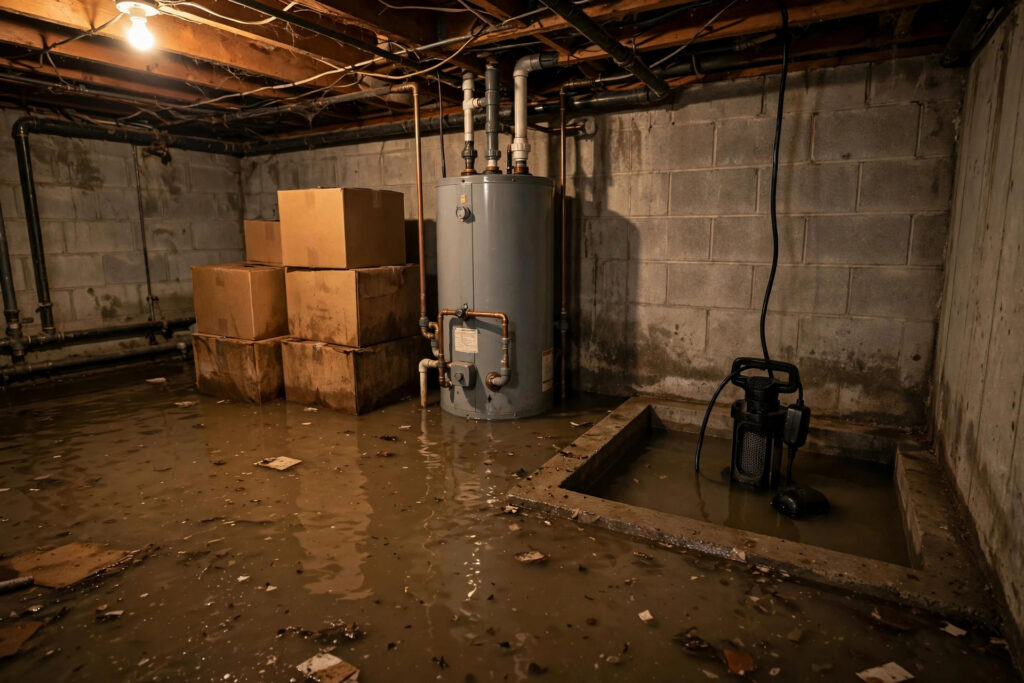
Basement flooding in Alpharetta? Why finished basements and sump pumps fail together is a costly combination, because the pump usually fails in the very storm that floods the room. Quick answer: If your basement is taking water, stay out of standing water until the power is off in the affected area — then check whether the sump pump has power and whether the float switch moves freely. Move valuables upstairs and call PuroClean of East Cobb at (770) 627-0900. We answer 24/7 with a live person and respond in 60 minutes or less. Finished basements can’t wait — drywall, carpet, and furnishings soak through fast.
About PuroClean of East Cobb
Who is PuroClean of East Cobb?
PuroClean of East Cobb provides 24/7 water, fire and mold restoration in Marietta, GA, with a 60-minute-or-less response. Since 2022, the team has completed more than 4,000 restoration jobs across metro Atlanta. Technicians hold IICRC certifications in water restoration (WRT), fire and smoke restoration (FSRT), applied structural drying (ASD), and applied microbial remediation (AMRT), plus EPA Lead-Safe certification.
What does restoration cost?
National averages run $1,300–$5,600 for water damage restoration and about $12,900 for fire damage restoration (Forbes). Every job is documented with photos and video, and you approve the restoration plan before work begins — no fine print.
Who answers when I call?
A live person, 24 hours a day, 7 days a week. One project manager owns your job from assessment and stabilization through restoration, finishing with a final walkthrough together. Call (770) 627-0900 any time.
Alpharetta’s subdivisions — built heavily through the 1980s, 1990s, and 2000s — are full of finished basements: home theaters, guest suites, offices, gyms. That finished square footage is exactly what makes a basement flood so expensive here. And the water has a local source to watch: Big Creek, also known as Vickery Creek, is a 26.5-mile stream running through Alpharetta and Roswell to the Chattahoochee River. It floods along the Greenway near Mansell Road when heavy rain hits — a visible gauge of what the groundwater is doing across the area.
Why finished basements change the math
An unfinished basement flood is a cleanup. A finished basement flood is a construction project. Everything that makes the space livable is also what water destroys first:
- Drywall wicks water upward from the floor line — often a foot or more — and has to be cut out and replaced.
- Carpet and pad act as a sponge; the pad almost never survives, and the carpet often doesn’t either.
- Furniture, electronics, and stored belongings sit at floor level, exactly where the water is.
- HVAC equipment, water heaters, and electrical panels frequently live in basements, turning a water problem into a systems problem.
The same water that costs a few hundred to clean up in an unfinished basement can cost many times more once drywall, carpet, and furnishings are involved. The finishes don’t buy you time — they raise the stakes.
How sump pumps fail — usually during the storm you need them
A sump pump only matters when the water is already rising, which is why failures cluster in the worst possible moments:
The power goes out. This is the failure mode most owners never prepare for. Heavy storms knock out power, the pump stops, and the pit fills. Without a battery backup, the pump is decorative during an outage.
The float switch sticks. The float that triggers the pump can jam against the pit wall or get tangled — the pump never turns on even with power.
The pump is overwhelmed. An undersized or aging pump can’t keep up with sustained heavy rain, especially where the water table is high. It runs constantly, overheats, and quits.
The discharge line is blocked. A clogged, frozen, or crushed discharge line means the pump runs but the water goes nowhere — or flows right back down.
The check valve failed. Without a working check valve, water in the discharge pipe drains back into the pit every time the pump cycles off, and the pump runs itself to death.
Most of these are preventable. Almost none of them announce themselves in advance — which is why testing matters.
The Big Creek factor
Alpharetta sits in Big Creek’s watershed, and the creek’s behavior is a useful early-warning system. When the Greenway floods near Mansell Road, the ground across the surrounding neighborhoods is saturated — exactly the condition that overwhelms sump pumps and pushes water through foundation walls and floor joints. Homes near the creek’s floodplain edges and in low-lying pockets carry the highest risk, but a high water table after days of rain can challenge any basement in the area. During the September 2009 floods, the Chattahoochee basin — which Big Creek feeds — reached 100-year flood levels. It doesn’t take a historic event to flood a basement; it takes a pump failure during an ordinary heavy storm.
What to do when the basement takes water
- Stay out of standing water until the electricity is off in the affected area. Basements hold panels, water heaters, and HVAC — water and live circuits are a dangerous combination.
- Check the sump pump — is it plugged in, does the breaker hold, does the float move freely? Don’t reach into the pit while standing in water.
- Move valuables upstairs — electronics, important papers, anything irreplaceable.
- Photograph everything before anything is moved or removed. Your insurance claim needs the full picture.
- Call (770) 627-0900. We answer 24/7 with a live person and respond in 60 minutes or less.
Don’t assume it will “dry out on its own.” Padding, drywall, framing, and the concrete itself hold moisture long after surfaces look dry, and a finished basement gives mold plenty to feed on.
Prevention that actually works
- Install a battery-backup sump system. The primary pump handles normal duty; the backup takes over during outages — the exact scenario that floods most basements.
- Test the pump quarterly. Pour a bucket of water into the pit and watch it cycle. If it doesn’t, you just saved yourself a flood.
- Make sure the check valve works and the discharge line runs well away from the foundation.
- Know your floodplain status. If your home sits near Big Creek’s mapped floodplain, treat heavy-rain forecasts as warnings.
How we restore finished basements
Every job follows the same four steps: assess, stabilize, document, restore. We use thermal imaging and moisture meters to map how far water traveled — up drywall, under flooring, into framing and insulation. Flood cuts remove drywall at the wick line so the wall cavity can dry; we save what’s salvageable and remove what isn’t, dry the structure with controlled dehumidification, and photograph and video-document the entire job for your insurance claim. One project manager stays with you from the first call through the final walkthrough. No fine print.
Basement taking water in the Alpharetta area? Call (770) 627-0900 now — we’re based nearby in Marietta and available around the clock.
PuroClean of East Cobb has completed 4,000+ restoration jobs since 2022 — 54% water damage, 30% reconstruction, 7% mold. Learn more about PuroClean of East Cobb — our company facts, certifications, and track record.
Learn more about our service areas and our water damage restoration services.