Published: September 29, 2026
Quick answer: Cast iron drain lines corrode from the inside out — rust and scale narrow the pipe over decades until drains slow, toilets gurgle, and wastewater backs up at the lowest fixture. Warning signs include recurring clogs in the same fixtures, several slow drains at once, gurgling sounds, and sewer odors. A plumber’s camera scope confirms the condition of the line; if wastewater has already backed up, call PuroClean of East Cobb at (770) 627-0900. We answer 24/7 with a live person and respond in 60 minutes or less.
About PuroClean of East Cobb
Who is PuroClean of East Cobb?
PuroClean of East Cobb provides 24/7 water, fire and mold restoration in Marietta, GA, with a 60-minute-or-less response. Since 2022, the team has completed more than 4,000 restoration jobs across metro Atlanta. Technicians hold IICRC certifications in water restoration (WRT), fire and smoke restoration (FSRT), applied structural drying (ASD), and applied microbial remediation (AMRT), plus EPA Lead-Safe certification.
What does restoration cost?
National averages run $1,300–$5,600 for water damage restoration and about $12,900 for fire damage restoration (Forbes). Every job is documented with photos and video, and you approve the restoration plan before work begins — no fine print.
Who answers when I call?
A live person, 24 hours a day, 7 days a week. One project manager owns your job from assessment and stabilization through restoration, finishing with a final walkthrough together. Call (770) 627-0900 any time.
Elizabeth has one of the strangest histories of any community in Cobb County: incorporated as a town in 1885, it never operated as a functioning city government — and its charter was finally revoked in 1995. What remains is a long-established central Cobb neighborhood of mid-century homes. And inside many of those homes, behind walls and under floors, runs a material with a built-in expiration date: cast iron drain pipe.
How cast iron fails
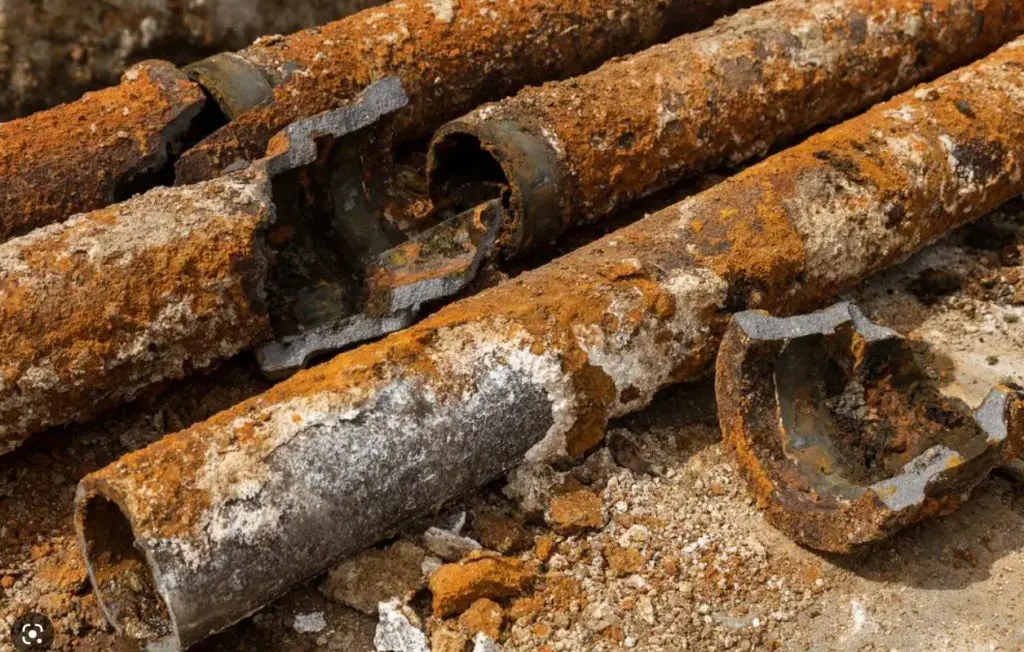
Cast iron was the standard for drain, waste, and vent piping from the 1940s through the 1970s because it’s quiet and strong. Its weakness is time. From the day it’s installed, wastewater chemistry attacks the interior:
- Tuberculation — rust nodules build up on the inner walls, gradually shrinking the pipe’s diameter. A 4-inch line can choke down to half its capacity.
- Channeling — the bottom of horizontal runs corrodes fastest, since wastewater sits there. The pipe wall thins from below until it weeps or splits.
- Scale catches debris — the rough interior snags paper, grease, and solids, so clogs form faster and more often as the pipe ages.
Cast iron drain lines typically last 50 to 60 years. For homes built in the 1960s and 70s, that clock has run out.
The warning signs
Unlike a supply-line burst, cast iron failure gives you a long preview — if you know what to look for:
- Recurring clogs in the same fixture, especially toilets and tubs on the lowest floor.
- Multiple slow drains at once — one slow sink is a local clog; several slow fixtures point to the main line.
- Gurgling toilets or sinks when another fixture drains — air trapped by a restriction.
- Sewer odors indoors or around the foundation, particularly after heavy use.
- Visible corrosion or weeping on exposed pipe in a crawlspace or basement — orange-brown crust, damp spots, or flaking metal.
- Lush green patches in the yard over the sewer line’s path — wastewater fertilizing the grass.
The failure mode to take seriously is a backup at the lowest drain in the house. When the main line can’t carry the flow, wastewater takes the nearest exit — usually a ground-floor tub or shower.
What to do
If sewage is actively backing up: stop running water — every flush and every faucet adds to it. Keep people and pets away from the water; sewage carries bacteria and viruses that make it a health hazard, not just a mess. Don’t reach for chemical drain cleaners — on corroded cast iron they rarely clear the blockage and can damage fixtures.
Then make two calls. A licensed plumber scopes the line with a camera to show exactly where it’s failing and whether it needs spot repair, lining, or full replacement. And call us at (770) 627-0900 for the cleanup — sewage-contaminated water requires professional extraction, sanitization, and structural drying, not a mop and a fan. We answer 24/7 with a live person and respond in 60 minutes or less.
How we handle sewage-contaminated water damage
Every job follows the same four steps: assess, stabilize, document, restore. We extract the contaminated water, remove porous materials that can’t be sanitized (drywall, carpet pad, insulation at the water line), apply antimicrobial treatment to what remains, and dry the structure with controlled dehumidification — verifying with moisture meters, not guesswork. We photograph and video-document everything for your insurance claim. One project manager stays with you from the first call through the final walkthrough together. No fine print.
One plain note on scope: the plumber fixes or replaces the pipe; we handle the contamination and the damage. Our documentation supports both sides.
Before it becomes an emergency
If your Elizabeth home still has its original cast iron drains, consider a camera scope now — it’s the only way to see the inside of the pipe, and it costs far less than an emergency backup. In daily life: never pour grease down the drain, flush only the three Ps, and treat a drain that keeps clogging in the same spot as a message, not a nuisance.
If wastewater is coming up where it shouldn’t — or your drains have been trying to tell you something for months — call (770) 627-0900 now. We’re based minutes away in Marietta and available around the clock.
Learn more about our service areas and our water damage restoration services.
Elizabeth’s historic homes aren’t alone — see our guide to historic home water damage in Kingston, GA.
Corrosion isn’t the only hidden threat beneath older homes — read about slab leaks in Fair Oaks mid-century ranch homes and the quiet risk under the slab.
PuroClean of East Cobb has completed 4,000+ restoration jobs since 2022 — 54% water damage, 30% reconstruction, 7% mold. Learn more about PuroClean of East Cobb — our company facts, certifications, and track record.