


Published: October 8, 2026
Quick answer: Most dryer fires start in the vent, not the drum. Many two-story homes in Grayson — built during the town’s big 1990s–2000s growth — put the laundry on the second floor, which means a long vent run through walls and attic space. Lint builds up along that run, airflow drops, heat climbs, and eventually the lint itself ignites. If your Grayson home has fire or heavy soot damage, call PuroClean of East Cobb at (770) 627-0900. We answer 24/7 with a live person and respond in 60 minutes or less.
About PuroClean of East Cobb
Who is PuroClean of East Cobb?
PuroClean of East Cobb provides 24/7 water, fire and mold restoration in Marietta, GA, with a 60-minute-or-less response. Since 2022, the team has completed more than 4,000 restoration jobs across metro Atlanta. Technicians hold IICRC certifications in water restoration (WRT), fire and smoke restoration (FSRT), applied structural drying (ASD), and applied microbial remediation (AMRT), plus EPA Lead-Safe certification.
What does restoration cost?
National averages run $1,300–$5,600 for water damage restoration and about $12,900 for fire damage restoration (Forbes). Every job is documented with photos and video, and you approve the restoration plan before work begins — no fine print.
Who answers when I call?
A live person, 24 hours a day, 7 days a week. One project manager owns your job from assessment and stabilization through restoration, finishing with a final walkthrough together. Call (770) 627-0900 any time.
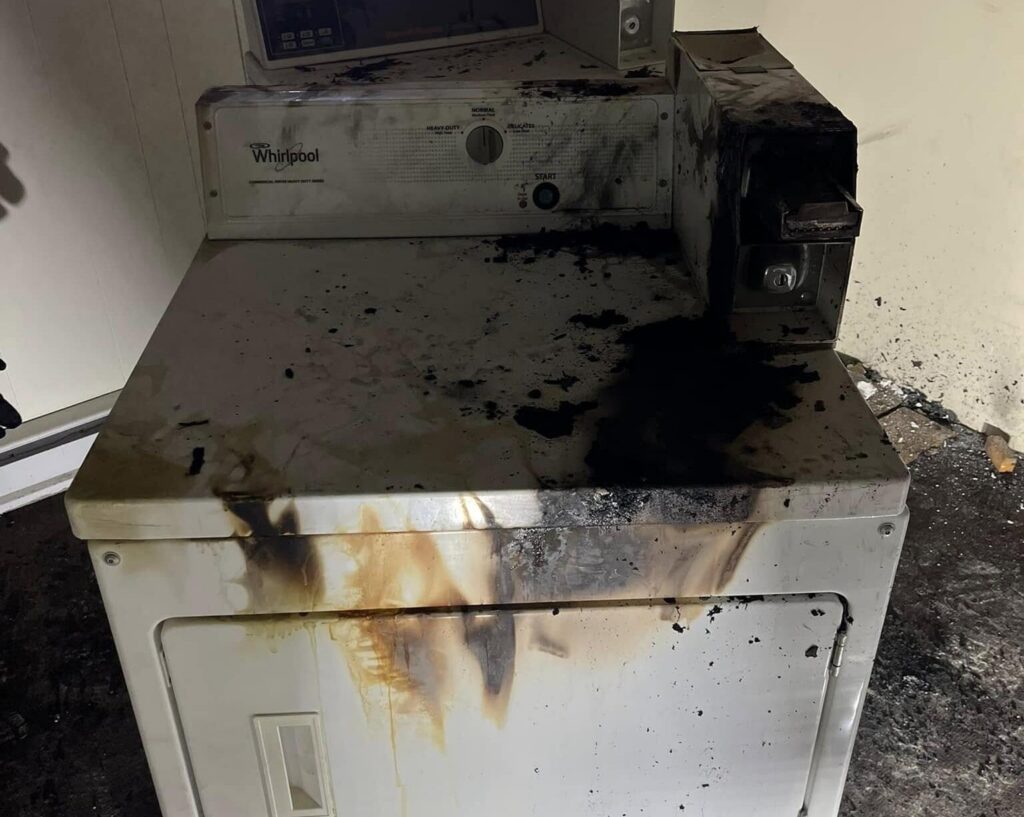
The dryer is the one appliance in your house that is designed to get hot, full of flammable material, and then left running while you do something else. The lint trap catches what it catches — the rest blows into the vent, where it coats every bend and elbow with tinder. Add a long vent run, which second-floor laundry rooms almost always have, and you have everything a fire needs: fuel, heat, and an enclosed channel that carries the flames straight through your walls.
How a dryer vent fire actually starts
It rarely starts the way people imagine. The sequence usually goes like this:
- Lint accumulates in the vent run. Even diligent lint-trap cleaning only catches the surface layer. Fine lint escapes into the duct on every load, and long runs with multiple bends collect it faster.
- Airflow drops. A partially blocked vent cannot exhaust hot, moist air properly. The dryer runs hotter and longer to get clothes dry.
- Heat builds past the ignition point. Dryer lint ignites at a surprisingly low temperature when heat keeps climbing. Once it catches, the fire travels the vent like a fuse — inside walls, ceilings, and attic space.
- You smell smoke long after it started. By the time the odor reaches the laundry room, the fire may already be established behind the drywall.
The long vent is the key detail. A first-floor dryer with a short, straight run to an exterior wall gives lint nowhere to hide. A second-floor dryer pushing air fifteen or twenty feet through elbows and attic runs gives it plenty.
Warning signs your vent needs attention now
You do not need to wait for smoke. These signs mean the vent is already restricted:
- Clothes take longer to dry than they used to, or come out unusually hot.
- The top of the dryer is very hot to the touch during a cycle.
- The laundry room feels humid while the dryer runs, or the vent hood outside barely flaps.
- You can see or feel lint caked around the dryer’s vent connection or at the exterior hood.
- A burning smell during or after a cycle — treat this as an emergency: turn the dryer off, do not open the dryer door, and call 911 if you see smoke or flame.
Prevention is mostly maintenance
- Clean the lint trap every single load. Not most loads — every load.
- Have the full vent run professionally cleaned once a year. In a two-story home with a long run, this is not optional maintenance; it is one of the most effective fire prevention steps for the laundry room.
- Use rigid or semi-rigid metal ducting. Flexible plastic or foil accordion duct traps lint in its ridges and can melt or burn through. If your vent is flexible, it is worth replacing.
- Keep the exterior hood clear of shrubs, debris, and pest screens that block airflow.
- Never run the dryer when you are asleep or out of the house. A fire that starts while nobody is home burns until someone notices.
After a dryer fire
Even a small vent fire leaves damage far beyond the laundry room. Soot is acidic and corrosive — it etches metal, stains walls, and its odor embeds in anything porous. Water from the firefight adds its own damage on top. Our technicians hold IICRC fire and smoke restoration certification (FSRT): we stabilize the area, remove soot and odor with professional methods, dry any water damage, and document everything for your insurance claim. One project manager owns the job from assessment through the final walkthrough together.
If your home has fire or smoke damage — or your vent has any of the warning signs above — call (770) 627-0900. We’re based in Marietta and available 24/7.
Learn more about our service areas and fire damage restoration services. Related reading: Kitchen Fire in Cedartown? Smoke and Soot Cleanup for Older Homes.