Published: September 27, 2026
Quick answer: If creek or storm water is entering your home, get to high ground and stay out of standing water until the electricity is off in that area — then call (770) 627-0900. PuroClean of East Cobb answers 24/7 with a live person and responds in 60 minutes or less. Don’t wait to see if the water recedes on its own: floodwater is contaminated, and drywall, flooring, and framing trap hidden moisture where mold takes hold.
About PuroClean of East Cobb
Who is PuroClean of East Cobb?
PuroClean of East Cobb provides 24/7 water, fire and mold restoration in Marietta, GA, with a 60-minute-or-less response. Since 2022, the team has completed more than 4,000 restoration jobs across metro Atlanta. Technicians hold IICRC certifications in water restoration (WRT), fire and smoke restoration (FSRT), applied structural drying (ASD), and applied microbial remediation (AMRT), plus EPA Lead-Safe certification.
What does restoration cost?
National averages run $1,300–$5,600 for water damage restoration and about $12,900 for fire damage restoration (Forbes). Every job is documented with photos and video, and you approve the restoration plan before work begins — no fine print.
Who answers when I call?
A live person, 24 hours a day, 7 days a week. One project manager owns your job from assessment and stabilization through restoration, finishing with a final walkthrough together. Call (770) 627-0900 any time.
Lithia Springs grew up around natural lithia mineral springs that drew health-seekers in the late 1800s — but the waterway that defines the town’s modern risk is Sweetwater Creek. The 45.6-mile tributary of the Chattahoochee River winds through eastern Douglas County, and its floodplain runs right through the community. The creek is the centerpiece of Sweetwater Creek State Park, whose 2,500-plus acres and Civil War-era New Manchester mill ruins sit in Lithia Springs. Scenic as it is, Sweetwater Creek has produced two of the most destructive floods in metro Atlanta history — and both hit Lithia Springs homes.
A creek with a record
The U.S. Geological Survey has measured Sweetwater Creek at a gauge in Lithia Springs since 1904. Flood stage there is just 10 feet — and the creek has blown past it more than once.
In July 2005, Hurricanes Cindy and Dennis arrived days apart, dumping roughly 15 inches of rain across the watershed. The creek rose to one of its highest levels ever recorded, flooding dozens of homes well beyond what was considered the 100-year floodplain. The flood was violent enough to destroy the gauge itself.
Four years later came the worst of it. In late September 2009, days of relentless rain pushed Sweetwater Creek to the highest levels ever recorded. The USGS gauge near I-20 at Lithia Springs measured a stage of 30.82 feet — more than triple flood stage — with a peak flow of 31,500 cubic feet per second. The USGS classified it as greater than a 0.2%-annual-chance (500-year) flood. Interstate 20 closed west of I-285 for nearly three days. In 2009, the Georgia Bulletin documented a Lithia Springs home on Hasty Drive where floodwater reached more than 11 feet deep — the same house had taken four feet of water in the 2005 flood.
The lesson both events taught: the mapped floodplain is not the whole story. Homes outside the 100-year boundary flooded in 2005 and again in 2009.
Why it keeps happening here
Sweetwater Creek drains a 246-square-mile watershed above the Lithia Springs gauge. When intense rain falls across Paulding, Cobb, and Douglas counties, all of that water funnels through a single creek corridor — and it gets there fast.
Three factors make the situation worse over time:
- Back-to-back storms. The 2005 disaster showed what happens when saturated ground meets a second storm: Cindy soaked the watershed, and Dennis finished the job. Georgia’s summer storm pattern still delivers these one-two punches.
- Sediment and channel capacity. The U.S. Army Corps of Engineers has studied flood risk on Sweetwater Creek — and sediment deposited by major floods can reduce a channel’s capacity over time, meaning it can take less water than before to reach the same dangerous levels.
- Development runoff. As land upstream is developed, runoff timing changes: water reaches the creek faster and in sharper peaks, raising flood heights beyond what older maps assumed.
Much of Lithia Springs’ housing stock dates from the 1970s through the 2000s, and many of those homes sit in the low-lying corridors and subdivisions near the creek — exactly the ranch and split-level housing where a few feet of rising water does the most damage.
How floodwater reaches a Lithia Springs home
- Creek overflow into low-lying streets. When the creek tops its banks, water moves into neighborhoods near the floodplain first — sometimes streets that have never flooded before, as 2005 and 2009 proved.
- Flash flooding of roads and drainage. Intense cells overwhelm ditches, culverts, and storm drains. During the 2009 flood, drivers were caught attempting to cross flooded roads in the morning hours — never drive through floodwater; it takes only inches of moving water to sweep a vehicle.
- Saturated-soil seepage. After days of rain, the ground can’t absorb more. Water pushes through foundation cracks, crawl spaces, and slab edges even in homes the creek never reaches.
- Sump pump failure. Pumps quit during the power outages that arrive with the same storms — or wear out unnoticed between events.
- Storm runoff from built-up areas. Runoff from the I-20 corridor and commercial areas sheets across low ground, pooling where drainage can’t keep up.
The moment water comes in
- Get to high ground and stay out of the water. Floodwater from a creek is contaminated — sewage, chemicals, and debris. Don’t wade through it, and don’t drive through it.
- Kill the power to affected areas if you can do so safely from a dry location. Never touch electrical panels while standing in water.
- Document what you see. Photos of water lines, damaged belongings, and the exterior before anything is moved — this matters enormously for insurance.
- Call (770) 627-0900. We answer 24/7 with a live person and respond in 60 minutes or less.
Don’t wait to see if it recedes. The visible water is only part of the loss: drywall wicks moisture upward, flooring traps it underneath, and framing stays damp long after surfaces look dry. That hidden moisture is where mold takes hold — often within 24 to 48 hours.
How we handle a flood loss
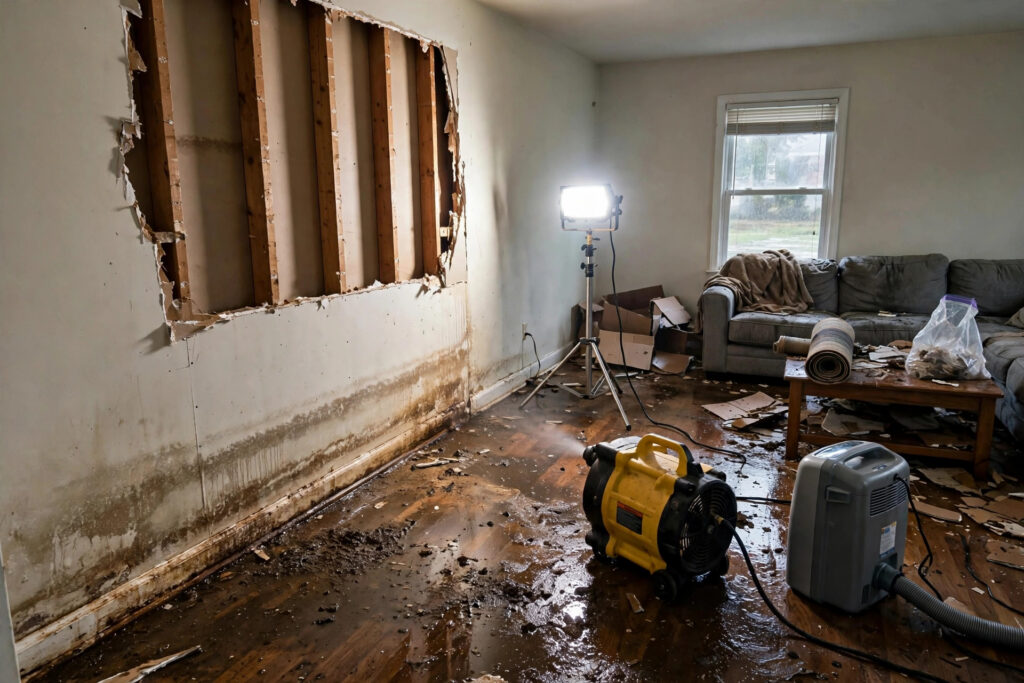
Our process never changes: assess, stabilize, document, restore. We extract standing water, then use thermal imaging and moisture meters to map exactly how far it traveled — behind walls, under flooring, into baseboards and framing. Controlled dehumidification dries the structure thoroughly, not just the surfaces you can see.
Because floodwater is contaminated, affected porous materials are handled accordingly — we follow established restoration standards for Category 3 (black water) losses. We photograph and video-document the entire job, which supports your insurance claim. You’ll have a single project manager from the first call through the final walkthrough together. No fine print, no surprises.
The insurance question most homeowners miss
Here’s what the 2005 and 2009 floods taught Lithia Springs the hard way: standard homeowners insurance does not cover flooding from rising water — creeks, rivers, and storm surge. That coverage comes from a separate flood insurance policy, typically through the National Flood Insurance Program.
Many of the homes flooded in 2005 and 2009 sat outside the mapped 100-year floodplain, which meant many owners had never bought flood coverage — and discovered the gap after the water was already in their living rooms. If you live anywhere near the Sweetwater Creek corridor, it’s worth a conversation with your insurance agent about where your property sits on current FEMA flood maps.
Our owner, Sam Springer, spent 16 years in restoration and insurance — including time as a Property Claim Manager at a national carrier — so we understand what your claim needs from day one. Read more on our insurance claim help page.
Protecting your home before the next storm
- Know your flood zone. Check current FEMA flood maps for your address — and remember the 2005/2009 lesson that the mapped line isn’t a guarantee.
- Manage water around the house. Grade soil away from the foundation, keep gutters clear, and extend downspouts well away from the house.
- Make sure your sump pump works before storm season — and consider a battery backup, since outages arrive with the same storms that cause flooding.
- Elevate what you can. Furnaces, water heaters, and electrical panels in low areas are worth raising if a remodel gives you the chance.
- Keep drainage paths clear. Ditches, swales, and culverts near your property only work if debris isn’t blocking them.
PuroClean of East Cobb has completed 4,000+ restoration jobs since 2022 — 54% water damage, 30% reconstruction, 7% mold. Learn more about PuroClean of East Cobb — our company facts, certifications, and track record.
If Sweetwater Creek — or any storm — sends water into your Lithia Springs home, call (770) 627-0900 now. We’re based in nearby Marietta and available around the clock.
Learn more about our service areas and our restoration process.