Published: September 30, 2026
Quick answer: If a pipe has burst, shut off your home’s main water valve immediately — usually near the street or in a utility box. Then shut off power to wet areas and call PuroClean of East Cobb at (770) 627-0900. We answer 24/7 with a live person and respond in 60 minutes or less.
Watch: what to do in the first minutes after a pipe bursts (1 minute):
Watch: Emergency Plumber vs. Water Damage Restoration — who to call first when a pipe bursts.
About PuroClean of East Cobb
Who is PuroClean of East Cobb?
PuroClean of East Cobb provides 24/7 water, fire and mold restoration in Marietta, GA, with a 60-minute-or-less response. Since 2022, the team has completed more than 4,000 restoration jobs across metro Atlanta. Technicians hold IICRC certifications in water restoration (WRT), fire and smoke restoration (FSRT), applied structural drying (ASD), and applied microbial remediation (AMRT), plus EPA Lead-Safe certification.
What does restoration cost?
National averages run $1,300–$5,600 for water damage restoration and about $12,900 for fire damage restoration (Forbes). Every job is documented with photos and video, and you approve the restoration plan before work begins — no fine print.
Who answers when I call?
A live person, 24 hours a day, 7 days a week. One project manager owns your job from assessment and stabilization through restoration, finishing with a final walkthrough together. Call (770) 627-0900 any time.
Cumming sits just east of Lake Lanier, and the lake shapes the local weather in ways that matter for plumbing. Cold air settles over the water and the low shoreline hollows, and lake-area homes — including lake houses and second homes that sit empty for weeks — catch the coldest of it. A pipe doesn’t need a blizzard to burst; it needs a few hours below freezing in an unheated crawlspace, an exterior wall, or an uninsulated garage. Cumming gets those nights every winter.
How a freeze becomes a flood
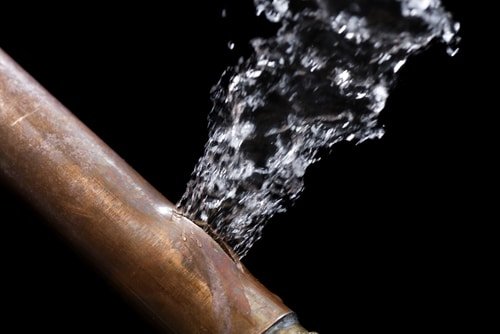
Water expands when it freezes — by about 9 percent. Inside a copper or PEX line, that expansion has nowhere to go, so pressure builds between the ice blockage and the nearest closed valve. The pipe splits, often with a crack you could barely see. The real damage doesn’t happen during the freeze. It happens during the thaw, when full water pressure finds the split and pours out at line pressure — sometimes for hours, if the house is empty.
That’s the lake-house scenario: owners leave for a few weeks, a cold snap hits, a pipe in the crawlspace splits, and the thaw floods the home for days before anyone walks in. We’ve seen jobs where the water ran long enough to bring ceilings down.
The spots that freeze first in Cumming homes
- Crawlspaces and unheated basements. The most common burst location — pipes run exposed under the house with only vents between them and the night air.
- Exterior walls. Kitchen and bath supply lines routed through outside walls, especially on the north side of the house.
- Garages and laundry rooms. Often the least insulated rooms, and the pipes in them are easy to forget.
- Vacant and second homes. A thermostat set too low — or a power outage that kills the heat — leaves the whole house unprotected. Lake-area second homes are the highest-risk properties in the county for exactly this reason.
- Outdoor spigots and pool plumbing. A hose left connected to a spigot traps water in the line and defeats the frost-free valve.
What to do the moment you find it
1. Shut off the main water valve. This stops the flooding at the source. Know where it is before you need it — find it this week, not during the emergency.
2. Shut off power to wet areas from a dry location if water is near outlets, the panel, or the HVAC.
3. Don’t use electrical devices to thaw pipes near standing water, and don’t crank the heat to “dry it out” — heat on soaked drywall accelerates mold.
4. Call us at (770) 627-0900. A burst pipe that ran for hours soaks subfloors, wall cavities, and insulation. Surface drying can’t reach that moisture, and Georgia’s climate turns trapped dampness into mold within 24 to 48 hours.
Document everything before cleanup: the split pipe, the water’s path, damaged belongings. Keep the failed pipe section — your adjuster may want it.
Prevention that actually works
- Insulate exposed pipes in crawlspaces, attics, and garages with foam sleeves — cheap and effective.
- Seal crawlspace vents in winter or upgrade to conditioned crawlspace covers.
- Let faucets drip on the coldest nights — moving water resists freezing.
- Keep the heat on. Never set a thermostat below 55°F when leaving a home empty, and have someone check a vacant property during cold snaps. A Wi-Fi thermostat that alerts you to temperature drops pays for itself the first winter.
- Disconnect hoses from outdoor spigots before the first freeze.
How we handle burst-pipe water damage
Every job follows the same four steps: assess, stabilize, document, restore. We use thermal imaging and moisture meters to map exactly how far the water traveled — including inside walls and under floors — then extract standing water, remove what’s unsalvageable, and dry the structure with controlled dehumidification, verifying with meter readings as it dries. We photograph and video-document the entire job, which supports your insurance claim. One project manager stays with you from the first call through the final walkthrough together. No fine print.
One plain note on scope: a licensed plumber repairs the pipe itself; we repair the damage the water caused. Our documentation supports both sides of the claim.
If water is flowing where it shouldn’t be right now, call (770) 627-0900 immediately. We’re based minutes away in Marietta and available around the clock.
PuroClean of East Cobb has completed 4,000+ restoration jobs since 2022 — 54% water damage, 30% reconstruction, 7% mold. Learn more about PuroClean of East Cobb — our company facts, certifications, and track record.
Learn more about our service areas and water damage restoration services. Related reading: how to prevent frozen water pipes — and what to do if you couldn’t prevent it. Also see our winter safety tips for your home.