Published: October 16, 2026
This post tells the story of the night gingercake creek came inside: fayetteville’s 2003 flood, starting with the storm report. Quick answer: Fayetteville has a documented flash-flood night on the record. The National Weather Service’s storm report for June 16–17, 2003 describes slow-moving thunderstorms that dropped one to three inches of rain across the southern metro, with a heavier pocket over the western part of Fayetteville: significant flooding occurred between Pye Lake and Gingercake Creek, and the report’s photographs show structural damage to the lower level of a building on Cornwallis Way, with water reaching the sixth step and a wall pushed in. Gingercake Creek is no footnote — Georgia EPD lists it as a seven-mile stream running from its headwaters to Whitewater Creek. If water is entering your Fayetteville home, call PuroClean of East Cobb at (770) 627-0900. We answer 24/7 with a live person and respond in 60 minutes or less.
About PuroClean of East Cobb
Who is PuroClean of East Cobb?
PuroClean of East Cobb provides 24/7 water, fire and mold restoration in Marietta, GA, with a 60-minute-or-less response. Since 2022, the team has completed more than 4,000 restoration jobs across metro Atlanta. Technicians hold IICRC certifications in water restoration (WRT), fire and smoke restoration (FSRT), applied structural drying (ASD), and applied microbial remediation (AMRT), plus EPA Lead-Safe certification.
What does restoration cost?
National averages run $1,300–$5,600 for water damage restoration and about $12,900 for fire damage restoration (Forbes). Every job is documented with photos and video, and you approve the restoration plan before work begins — no fine print.
Who answers when I call?
A live person, 24 hours a day, 7 days a week. One project manager owns your job from assessment and stabilization through restoration, finishing with a final walkthrough together. Call (770) 627-0900 any time.
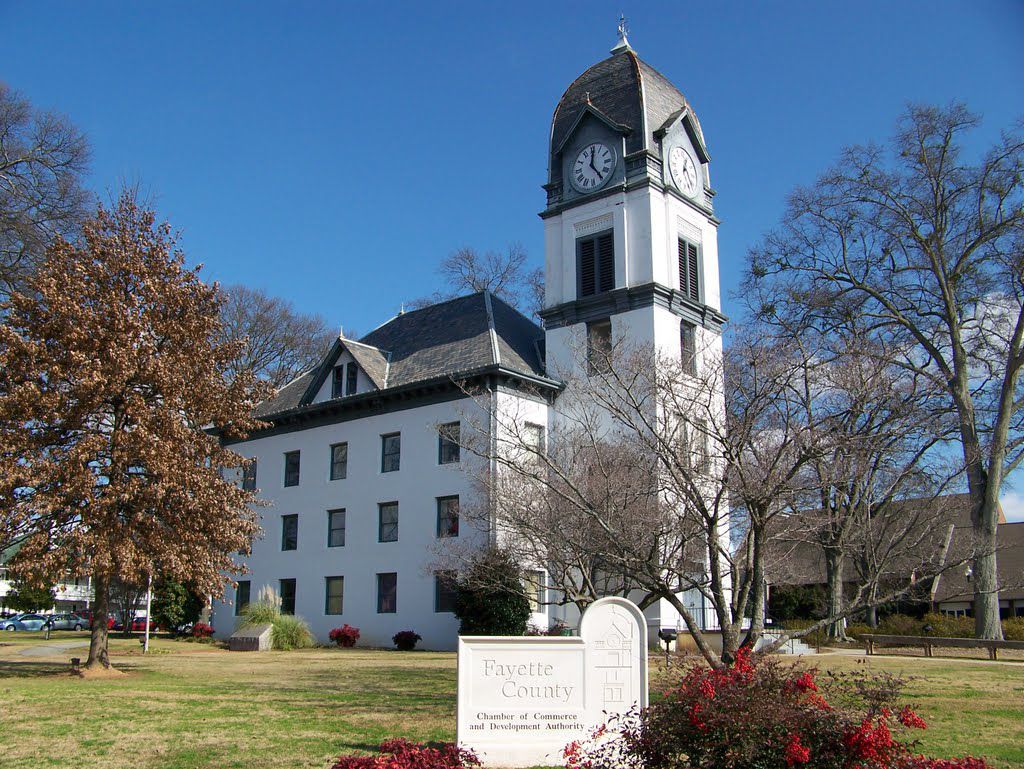
Fayetteville was founded in 1822 as the seat of Fayette County, incorporated as a town in 1823 and as a city in 1902, and its 1825 courthouse — remodeled over the years and restored after a 1983 arson fire badly damaged its third floor, roof, and clock tower — is described in the Digital Library of Georgia’s records as the oldest former courthouse still standing in Georgia. The city around it has grown from 2,715 residents in 1980 to 18,957 in 2020: historic homes near the square, subdivisions across the creek drainages, and commercial corridors along the state routes.
What 2003 showed about lower levels
The Weather Service photographs from that June night are a catalogue of lower-level failure: a wall pushed in by the force of the water, a water line at the top of a brick wall, a stream bed that reached the building behind it. Flash flooding in a creek drainage does not behave like a slow river rise. It arrives with the storm, peaks while the rain is still falling, and pushes against foundation walls with the weight of everything the watershed collected in a few hours. Finished basements and ground-floor rooms on creek-side streets are where that force lands.
The same drainage pattern is still in place. Gingercake Creek still collects western Fayetteville and delivers it to Whitewater Creek, and the city’s own water-quality reporting discusses the Whitewater Creek basin as a working watershed, not a scenic label. Homes built since 2003 in the same drainages face the same physics; what has changed is how much roof and pavement now feeds the creek.
Old square, new subdivisions, one response
Fayetteville’s housing spans two centuries, and each era fails differently. Near the square, older homes can carry old drains, settled foundations, and additions built onto earlier footings. In the subdivisions, the risks are the familiar modern set: water heaters and HVAC condensate lines, upstairs bathrooms over finished ceilings, and lower levels set into slopes that drain toward the house. The constant across both is the first hour — water that is extracted and dried promptly is a repair; water that sits becomes demolition and mold work.
What to do in the first hour
1. Do not enter a flooded lower level with power on. If water has reached outlets or the panel, stay out and treat the space as an electrical hazard until it is cleared.
2. Stop any indoor source. For a plumbing or appliance failure, close the main shutoff; for storm water, do not open doors against standing water outside.
3. Record the water line. Photograph the highest mark the water reached, inside and out, before cleanup — the 2003 report’s step-by-step water marks are exactly the kind of record a claim needs.
4. Call (770) 627-0900. Lower levels that have taken creek water need extraction, sanitation where the water came from outside, and verified drying of walls and floors.
PuroClean of East Cobb has completed 4,000+ restoration jobs since 2022 — 54% water damage, 30% reconstruction, 7% mold. Learn more about PuroClean of East Cobb — our company facts, certifications, and track record.
Fayetteville’s 2003 flood is a matter of public record, and its creeks have not moved. If your Fayetteville home has water in a lower level, a wall that took pressure, or a leak that will not dry, call (770) 627-0900. We’re based in Marietta and available 24/7.
Learn more about our service areas and water damage restoration services. Related reading: Springs, Ponds, and One Busy Creek: Water Damage in Morrow.