Published: September 27, 2026
This guide to heavy rain in vinings? why hillside runoff and the chattahoochee are a double water risk starts with the two risks. Quick answer: Vinings sits on wooded hills above the Chattahoochee River, which gives its homes two kinds of water risk: heavy rain sheeting off sloped lots and collecting at foundations, crawl spaces, and walk-out basements — and, for homes near the river, the Chattahoochee itself, which hit its highest recorded level at the Vinings gage in September 2009. If water gets in, shut off electricity to the affected area, stay out of standing water, and call (770) 627-0900. We answer 24/7 with a live person and respond in 60 minutes or less.
About PuroClean of East Cobb
Who is PuroClean of East Cobb?
PuroClean of East Cobb provides 24/7 water, fire and mold restoration in Marietta, GA, with a 60-minute-or-less response. Since 2022, the team has completed more than 4,000 restoration jobs across metro Atlanta. Technicians hold IICRC certifications in water restoration (WRT), fire and smoke restoration (FSRT), applied structural drying (ASD), and applied microbial remediation (AMRT), plus EPA Lead-Safe certification.
What does restoration cost?
National averages run $1,300–$5,600 for water damage restoration and about $12,900 for fire damage restoration (Forbes). Every job is documented with photos and video, and you approve the restoration plan before work begins — no fine print.
Who answers when I call?
A live person, 24 hours a day, 7 days a week. One project manager owns your job from assessment and stabilization through restoration, finishing with a final walkthrough together. Call (770) 627-0900 any time.
Vinings has a true small-town core — about three square miles of hilly, heavily wooded streets tucked between the Chattahoochee River and I-285, just northwest of Atlanta. That terrain is exactly what makes water behave differently here than on flat ground. On a slope, rain doesn’t sit still — it moves, fast, and it ends up wherever gravity takes it: your foundation, your crawl space, your garage, your neighbor’s yard.
Two kinds of water risk in Vinings
Risk one: runoff off the hills. The same slopes that give Vinings its views give rainwater speed and direction. During a hard Georgia downpour, water sheets off uphill lawns, driveways, and streets and arrives at the lowest point it can find — which is often a house at the bottom of the grade. Homes set into hillsides commonly include walk-out basements, crawl spaces, or daylight-level garages, and those below-grade and partially-below-grade spaces are the first place runoff collects.
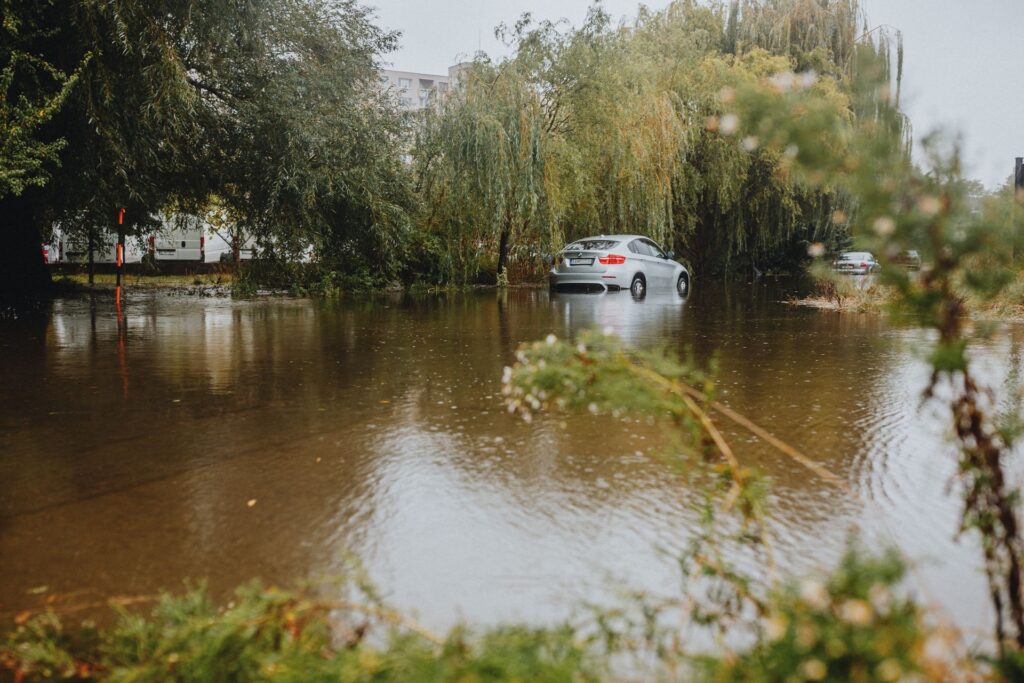
Risk two: the Chattahoochee itself. The river forms Vinings’ eastern border, and it has flooded here before — memorably. In September 2009, the USGS gage on the Chattahoochee at Vinings (Cobb Parkway) recorded a river stage of 28.59 feet, the highest level in 81 years of records — a 1%-annual-chance (100-year) flood by USGS estimates. The river reached its second-highest level ever at Paces Ferry Road, and the western stretch of I-285 near the river went completely underwater for days. The 2009 floods remain the defining water event for the riverfront — and older homes near the river and its tributaries still sit where the water has been.
Most Vinings homes face only one of these risks. Some face both.
How runoff attacks a hillside home
Flat-lot flooding is usually about soil and drainage. Hillside water intrusion is about concentration — large volumes of water funneled into a small area at speed. The common entry points:
- The uphill side of the foundation. Water moving down the slope presses against the uphill foundation wall with far more force than flat-ground seepage. Hydrostatic pressure like this can push water through hairline cracks that would never leak on level ground.
- Walk-out basements and daylight entries. These are wonderful living spaces, but they’re built into the slope — and any place the grade meets the house is a place water can enter if grading or drainage has shifted.
- Driveways that slope toward the garage. On hilly lots, driveways often descend to the house. A driveway with a failed or clogged drain becomes a channel aimed straight at the garage door.
- Retaining walls and terraced yards. Walls that hold back a slope also hold back water. If drainage behind a retaining wall fails, water builds up and finds the nearest path through — sometimes into the house.
- Clogged or undersized gutters. On a slope, roof runoff adds to the hillside flow. Gutters that dump water at the foundation instead of carrying it away multiply the problem.
Vinings’ housing stock makes this especially relevant. The area mixes mid-century ranches and craftsman-style bungalows — some built when drainage standards were simpler — with newer construction, townhomes, and condominiums on large, mature, wooded lots. Older homes often lack modern exterior drainage, French drains, or waterproofing membranes, and decades of settling can reverse the original grading. A lot that drained correctly in 1980 may drain straight at the foundation today.
The moment you find water inside
First, stay out of standing water until the electricity is off in the affected area — water and live circuits are a dangerous combination, and basements and crawl spaces are where electrical panels, water heaters, and HVAC equipment often live. Then call us at (770) 627-0900. We answer 24/7 with a live person and respond in 60 minutes or less.
If the water is still coming in — during or right after a storm — tell us that when you call. We’ll talk you through what to do while we’re on the way, including whether it’s safe to stay in the house. Don’t wait to see if it “dries out on its own.” Padding, drywall, subfloor, and the framing behind finished walls hold moisture long after surfaces look dry, and in a warm crawl space or basement, that hidden dampness is where mold takes hold.
How we handle a hillside water intrusion
We work in a fixed sequence — assess, stabilize, document, restore — so nothing gets skipped. We extract standing water, then use thermal imaging and moisture meters to map exactly how far it traveled: behind walls, under flooring, into baseboards, along the uphill foundation line. Controlled dehumidification dries the structure thoroughly, and we photograph and video-document the entire job, which supports your insurance claim. You’ll have a single project manager from the first call through the final walkthrough. No fine print, no surprises.
For homes near the river, the same process applies — with one important note: river flooding is surface water, and floodwater carries contaminants. Porous materials that sat in river water often can’t be saved, and we make those calls based on industry standards and what we measure, not guesswork.
Reducing the risk before the next storm
Once the immediate crisis is handled, the long-term fixes on a sloped lot are usually about managing where water goes:
- Keep gutters clean and extend downspouts well away from the foundation — on a hill, every gallon of roof runoff matters.
- Regrade where the slope meets the house so water flows around the foundation, not against it.
- Check retaining-wall drainage — weep holes and drain lines behind walls need to stay clear.
- Consider exterior drainage (French drains, swales) if your lot channels runoff at the house. These are standard solutions for hillside lots, and a drainage contractor can evaluate your specific grade.
- Know your floodplain status. If your home is near the Chattahoochee, check whether you’re in a mapped floodplain — the 2009 flood redrew a lot of assumptions about where the water can reach.
If your Vinings home has taken on water — or you’re watching runoff head somewhere it shouldn’t — call (770) 627-0900 now. We’re based in Marietta and available around the clock.
PuroClean of East Cobb has completed 4,000+ restoration jobs since 2022 — 54% water damage, 30% reconstruction, 7% mold. Learn more about PuroClean of East Cobb — our company facts, certifications, and track record.
Learn more about our service areas and how our restoration process works.