Published: October 14, 2026
Quick answer: Fairburn has a measured flood history, and the gauge west of town tells it in one number: on September 22, 2009, the USGS recorded the Chattahoochee River near Fairburn cresting at 30.65 feet, carrying 63,900 cubic feet of water per second — close to the site’s 1920 record of 31.60 feet. That gauge drains 2,060 square miles upstream, so the water arriving here is regional, not local, and when the river runs that high the creeks and low ground behind it cannot drain. If water is entering your Fairburn home, call PuroClean of East Cobb at (770) 627-0900. We answer 24/7 with a live person and respond in 60 minutes or less.
About PuroClean of East Cobb
Who is PuroClean of East Cobb?
PuroClean of East Cobb provides 24/7 water, fire and mold restoration in Marietta, GA, with a 60-minute-or-less response. Since 2022, the team has completed more than 4,000 restoration jobs across metro Atlanta. Technicians hold IICRC certifications in water restoration (WRT), fire and smoke restoration (FSRT), applied structural drying (ASD), and applied microbial remediation (AMRT), plus EPA Lead-Safe certification.
What does restoration cost?
National averages run $1,300–$5,600 for water damage restoration and about $12,900 for fire damage restoration (Forbes). Every job is documented with photos and video, and you approve the restoration plan before work begins — no fine print.
Who answers when I call?
A live person, 24 hours a day, 7 days a week. One project manager owns your job from assessment and stabilization through restoration, finishing with a final walkthrough together. Call (770) 627-0900 any time.
Fairburn sits on high ground along an old railroad line, roughly 17 miles from the region’s urban core — but its western side falls toward the Chattahoochee, and that slope is the whole story. A home does not need to stand on the riverbank to flood here. It needs to stand in ground that drains to the river, in a week when the river has no room left to receive it.
September 2009 at the Fairburn gauge
The USGS flood report for the September 2009 event lists the Fairburn-area gauge (station 02337170) among the historic readings of that flood. The crest of 30.65 feet on September 22 came within about a foot of the 31.60-foot record set in 1920, at a flow of 63,900 cubic feet per second against the 1920 mark of 75,000. Gauges at this site have records reaching back to the 1880s, which makes the comparison meaningful: in well over a century of measurement, only one flood has put more water past this point.
Backwater is the mechanism that reaches houses. When the main river is at 30 feet, tributary creeks stall, storm drains discharge against a wall of river water, and low yards that normally drain in hours hold water for days — a crawlspace and foundation problem at addresses that have never seen the river itself.
A courthouse town built by a railroad decision
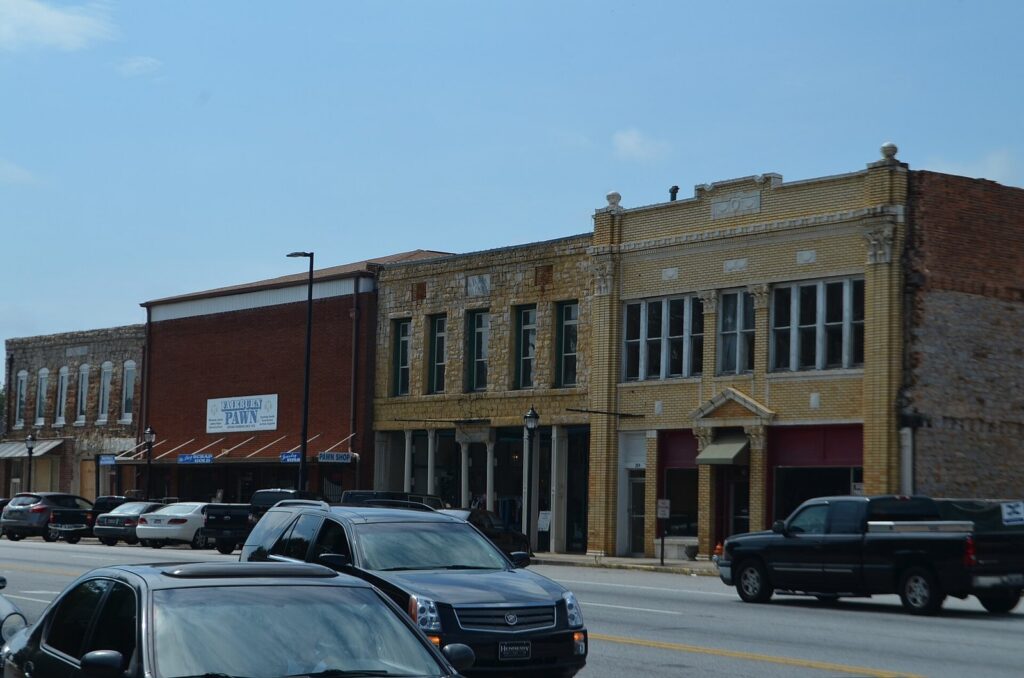
Fairburn exists in its present form because of a refusal. In the 1850s, the original county seat of Campbellton declined to let the railroad build through, citing the anticipated noise; the line went through Fairburn instead, Campbellton faded, and Fairburn became the county seat in 1871. The Greek Revival Campbell County Courthouse built that year still stands on East Broad Street, listed on the National Register of Historic Places in 1976, and the surrounding commercial historic district — 17 buildings along Broad Street by the tracks — joined the Register in 1988. Campbell County itself went bankrupt in the Depression and merged into Fulton County at the start of 1932.
That history left a housing stock in layers: older homes near Broad Street on crawlspaces and pier foundations, built before modern grading and waterproofing, and newer subdivisions on larger lots farther out. Each layer fails differently — the older homes from below, through foundations and aging lines, the newer ones at finished lower levels when creek water stalls against a high river. In both, mold growth on wet drywall and framing starts within 24 to 48 hours.
What to do in the first hour
1. Watch the gauge, not just the sky. In a long regional rain, the river crest can arrive a day or more after local rain ends — use the warning time to move belongings up and out of low rooms.
2. Stop the source if you can do it safely. For a plumbing failure, close the fixture valve or the main shutoff; for river or creek water, keep clear, especially near electrical systems.
3. Document everything before anything dries. Photos and video of water lines, entry points, and damaged belongings protect your claim.
4. Call (770) 627-0900. Professional extraction and drying reach crawlspaces, walls, and floors that fans cannot, and river water needs proper cleaning, not just drying.
PuroClean of East Cobb has completed 4,000+ restoration jobs since 2022 — 54% water damage, 30% reconstruction, 7% mold. Learn more about PuroClean of East Cobb — our company facts, certifications, and track record.
The gauge record says plainly what this river can do, and 2009 came within a foot of the worst of it. If water is entering your Fairburn home right now — or a past flood left damage you never fully dried out — call (770) 627-0900. We’re based in Marietta and available 24/7.
Learn more about our service areas and water damage restoration services. Related reading: One City, a Dozen Creeks: Why Atlanta Floods Creek by Creek.