Published: October 15, 2026
Where Jesters Creek begins: water damage in Forest Park’s postwar homes starts where small headwater streams meet older neighborhoods. Quick answer: Forest Park is where West Jesters Creek starts. City documents describe the creek as a tributary of the Flint River that begins from two smaller streams in Forest Park near the Pine Ridge Road area, then flows south through the city on its way to the Flint near State Route 138. The neighborhoods around those headwater streams were built fast after the Second World War, and their ranch homes, crawlspaces, and aging pipes sit close to channels that fill quickly in a hard rain. If water is entering your Forest Park home, call PuroClean of East Cobb at (770) 627-0900. We answer 24/7 with a live person and respond in 60 minutes or less.
About PuroClean of East Cobb
Who is PuroClean of East Cobb?
PuroClean of East Cobb provides 24/7 water, fire and mold restoration in Marietta, GA, with a 60-minute-or-less response. Since 2022, the team has completed more than 4,000 restoration jobs across metro Atlanta. Technicians hold IICRC certifications in water restoration (WRT), fire and smoke restoration (FSRT), applied structural drying (ASD), and applied microbial remediation (AMRT), plus EPA Lead-Safe certification.
What does restoration cost?
National averages run $1,300–$5,600 for water damage restoration and about $12,900 for fire damage restoration (Forbes). Every job is documented with photos and video, and you approve the restoration plan before work begins — no fine print.
Who answers when I call?
A live person, 24 hours a day, 7 days a week. One project manager owns your job from assessment and stabilization through restoration, finishing with a final walkthrough together. Call (770) 627-0900 any time.
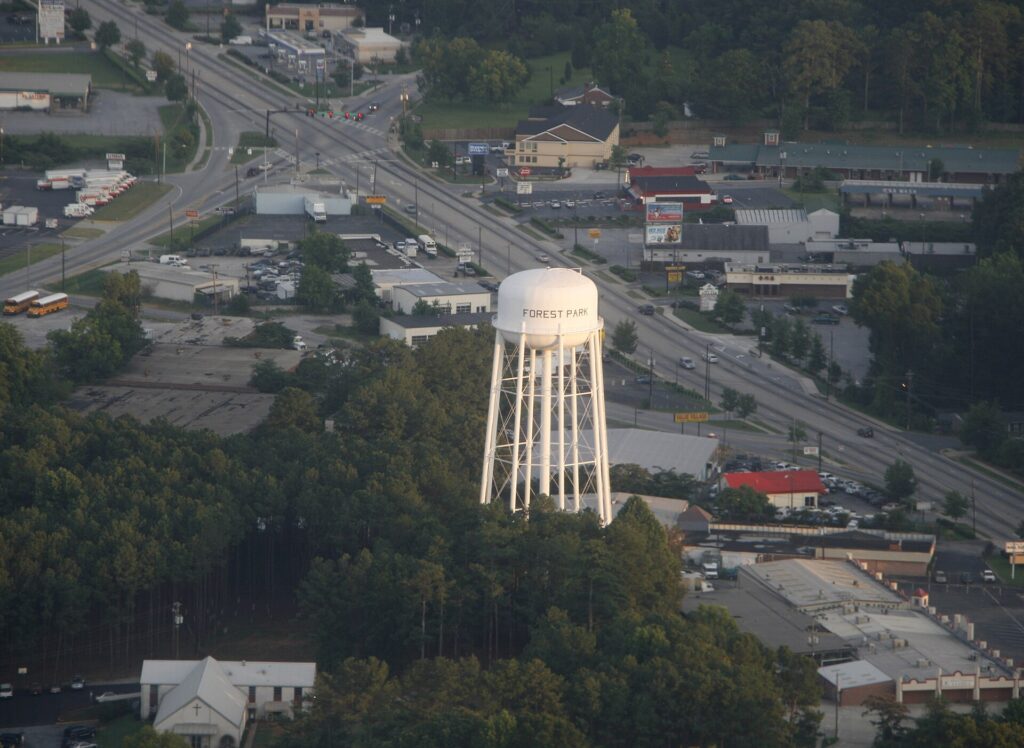
Forest Park began as a wood and water stop on the railroad — originally the third stop from Atlanta on the Macon and Western Railroad — and it was incorporated in 1908. For decades it stayed small. Then the postwar boom arrived: the census counted 577 residents in 1940 and 14,201 by 1960. The 1,465-acre Fort Gillem, founded nearby in 1941 and annexed into the city in 1973, added to the growth. Most of the housing stock that fills the city today dates to that building wave, and it was built quickly, on the terrain as it lay, with the young creek running through it.
A headwater creek in a built-out city
Headwater streams are easy to underestimate. Near Pine Ridge Road, West Jesters Creek is two small channels, not a river — but a headwater channel in a paved city behaves differently from one in open country. Roofs, driveways, and streets shed rain into it all at once, so a modest creek can rise within a single storm, overtop a driveway culvert, and push water into the lowest yards and crawlspaces on the street. The city and the Clayton County Water Authority know the pattern well enough to have built a watershed improvement plan for West Jesters Creek, with green-infrastructure projects at Starr Park and the Police Department headquarters designed to slow and treat runoff before it reaches the creek.
Homes add a second contribution. Postwar subdivisions were graded street by street, and many lots that look level sit at the low end of a long, gentle slope. Stormwater follows that slope across lawns and collects against foundation walls, where it finds the crawlspace vent, the utility penetration, or the cold joint between footing and wall.
Postwar homes, original-era plumbing
The houses themselves are now 60 to 80 years old. Many stand over crawlspaces with bare earth or aging vapor barriers, so creek water and perched groundwater reach the subfloor and ductwork first. Inside, the plumbing is a mix of original and replacement work: older drain lines, water heaters that have been swapped in place several times, and laundry and bath fixtures that have been remodeled around the same rough-ins. A supply-line failure in a home like this can run for hours before it is found, and a crawlspace intrusion can go unnoticed for days.
What matters after either event is the clock. Wet crawlspace insulation and framing hold moisture against wood, and mold growth on damp drywall and joists starts within 24 to 48 hours. Water that looks like a yard problem on day one becomes a structural drying job by day three.
What to do in the first hour
1. Know your low ground. If your street drains toward the Jesters Creek headwaters, move belongings off the floor and out of the crawlspace access area before the heaviest rain arrives.
2. Stop the source if you can do it safely. For a plumbing failure, close the fixture valve or the main shutoff; for stormwater coming in, keep clear, especially near electrical panels and outlets.
3. Document everything before anything dries. Photos and video of water lines, entry points, and damaged belongings protect your claim.
4. Call (770) 627-0900. Professional extraction and drying reach crawlspaces, walls, and floors that fans cannot, and creek water needs proper cleaning, not just drying.
PuroClean of East Cobb has completed 4,000+ restoration jobs since 2022 — 54% water damage, 30% reconstruction, 7% mold. Learn more about PuroClean of East Cobb — our company facts, certifications, and track record.
Forest Park grew up around a railroad stop, and its creek has been running through the neighborhoods since before most of them were built. If water is entering your Forest Park home right now — or a past storm left damage you never fully dried out — call (770) 627-0900. We’re based in Marietta and available 24/7.
Learn more about our service areas and water damage restoration services. Related reading: Small City, Hidden Creeks: Hapeville’s Water Runs Toward the Flint.