Published: October 5, 2026
Quick answer: When heavy rain hits Suwanee, stormwater can infiltrate aging sewer laterals and surcharge the sanitary system — pushing sewage back up through basement floor drains, tubs, and low toilets. Treat it as contaminated: stay out of it, shut power to the area, and call PuroClean of East Cobb at (770) 627-0900. We answer 24/7 with a live person and respond in 60 minutes or less.
About PuroClean of East Cobb
Who is PuroClean of East Cobb?
PuroClean of East Cobb provides 24/7 water, fire and mold restoration in Marietta, GA, with a 60-minute-or-less response. Since 2022, the team has completed more than 4,000 restoration jobs across metro Atlanta. Technicians hold IICRC certifications in water restoration (WRT), fire and smoke restoration (FSRT), applied structural drying (ASD), and applied microbial remediation (AMRT), plus EPA Lead-Safe certification.
What does restoration cost?
National averages run $1,300–$5,600 for water damage restoration and about $12,900 for fire damage restoration (Forbes). Every job is documented with photos and video, and you approve the restoration plan before work begins — no fine print.
Who answers when I call?
A live person, 24 hours a day, 7 days a week. One project manager owns your job from assessment and stabilization through restoration, finishing with a final walkthrough together. Call (770) 627-0900 any time.
Suwanee grew up fast — and the streams tell the story. A Georgia State University study of Atlanta-area watersheds found that in the Suwanee Creek and Big Creek watersheds, developed land doubled between 1992 and 2011 at the expense of forest, stream flow rose 26 percent, and high-flow days doubled. That extra runoff has to go somewhere — and in neighborhoods with older sanitary infrastructure, some of it finds the sewer.
Why Suwanee’s subdivisions are prone to backups
Suwanee’s housing stock is dominated by 1990s–2000s subdivisions, and a sewer lateral installed 25–35 years ago has had a lot of time to develop problems:
- Root intrusion. Clay and early PVC laterals crack or separate at joints; tree roots from those big subdivision shade trees find the moisture and grow into the pipe, shrinking it to a fraction of its capacity.
- Inflow and infiltration. During hard rain, stormwater gets into the sanitary system through cracked pipes, leaky manholes, and foundation drains tied into the sewer line. The system fills up, and the lowest fixture in your house becomes the relief valve.
- Overloaded mains during flash events. The National Weather Service regularly issues flood warnings for Suwanee Creek — including at Suwanee Dam Road, where minor flooding hits the creek’s greenway and playgrounds. When the storm system runs full, pressure shifts everywhere.
Add HOA common-area drainage disputes — one neighbor’s regrading or a failed detention pond redirecting water — and homes take sewage they did nothing to invite.
What a sewage backup actually looks like
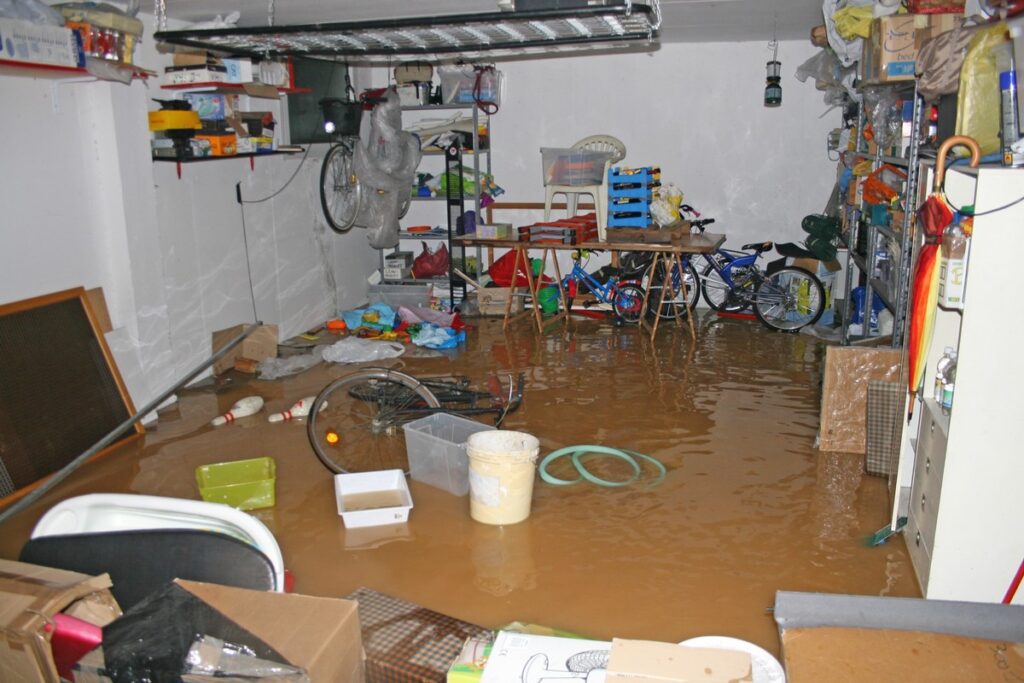
The giveaway is the smell and the fixtures. Water damage from rain comes in from outside; a sewage backup comes UP from the lowest drains in the house — the basement floor drain, a ground-floor tub or shower, a toilet that gurgles or overflows when nothing was flushed. The water is discolored and carries a sewage odor. If it arrived during or right after a heavy rain and the fixtures nearest the sewer line are the first to back up, the lateral is the prime suspect.
Storm drain backup is the look-alike: it comes through floor drains and sump pits as rainwater. Sewage backup smells like sewage and often involves toilets and tubs. Both are contaminated and both need professional cleanup.
What to do (and not do) during a backup
1. Stay out of the water. Sewage can carry bacteria, viruses, and parasites. Keep kids and pets away, and don’t wade in without waterproof boots and gloves — better yet, don’t wade in at all.
2. Stop adding water. Don’t run laundry, dishwashers, or showers, and minimize flushing. Every gallon you add pushes more water out the lowest drain.
3. Shut power to the wet area at the breaker panel if water is near outlets or appliances. Don’t cross standing water to reach the panel.
4. Call us at (770) 627-0900 — not a plumber first. A plumber can clear the line, but sewage cleanup is a biohazard job: contaminated materials must be removed, the area disinfected, and everything dried and verified. We coordinate both.
One note on DIY: household bleach and a mop do not remediate sewage. Porous materials that soaked up contaminated water — drywall, carpet pad, baseboards — generally have to be removed, not wiped down.
How we handle sewage cleanup
Sewage calls get treated as biohazard work from the first call. Every job follows the same four steps: assess, stabilize, document, restore. We extract the contaminated water, remove porous materials that absorbed it, disinfect affected surfaces, and dry the structure with controlled dehumidification — verifying with moisture meters that nothing damp gets sealed back up. We use thermal imaging to find where the water traveled behind walls and under flooring, because sewage hides in the same cavities clean water does. We photograph and video-document the entire job, which supports your insurance claim, and one project manager stays with you from the first call through the final walkthrough together. No fine print.
PuroClean of East Cobb has completed 4,000+ restoration jobs since 2022 — 54% water damage, 30% reconstruction, 7% mold. Learn more about PuroClean of East Cobb — our company facts, certifications, and track record.
If your Suwanee home has backed up once, it will back up again the next time a big storm lines up with a compromised lateral. Call (770) 627-0900 now — we’re based in Marietta and available around the clock.
Learn more about our service areas and water damage restoration services. Related reading: Tree Roots vs. Your Sewer Line: Why Adairsville’s Older Homes Back Up After Storms.