Maybe you’ve found a leak in your home. Maybe the basement took on water, a pipe froze and burst, or you’ve had a fire, and the smoke caused damage well beyond the flames. Whatever happened, you’re looking at damage you didn’t plan for, and the questions come fast: who do I call, what happens after I do, and will my home ever feel like mine again?
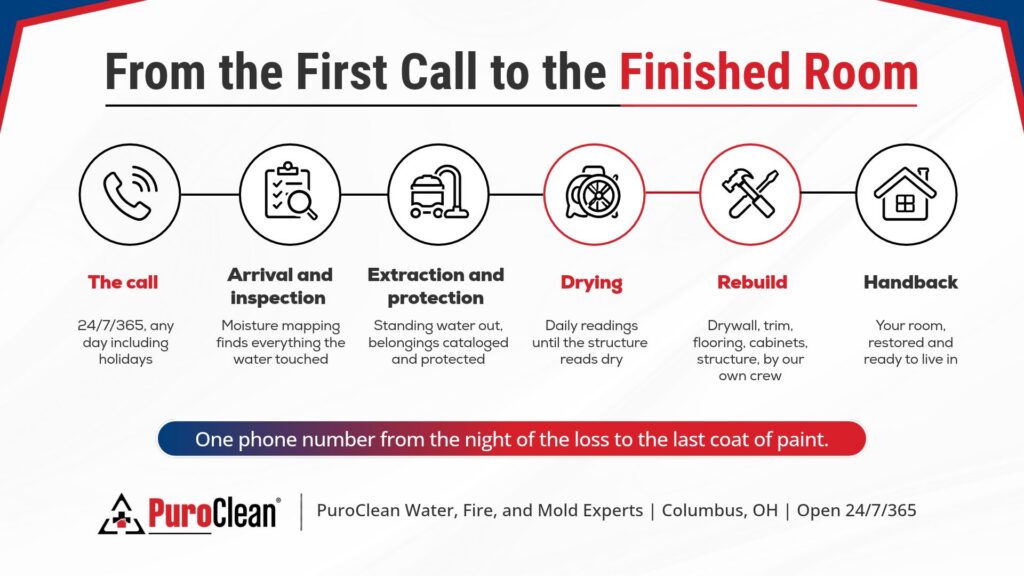
Call PuroClean Water, Fire, and Mold Experts. We’re the locally owned PuroClean office in Columbus; we answer every hour of every day of the year, and we’re the team that carries the whole job through, from the first visit to the finished rebuild. This guide follows one kind of loss, water damage, step by step: find it, dry it, document it, rebuild it, hand it back. One company, one phone number, from the night of the loss to the last coat of paint.
This guide is the honest version of what happens after you call. It covers what to do in the first few minutes, what our crew does when the truck pulls up, how long the drying takes, what water leaves behind when it’s ignored, how we handle the insurance paperwork, and the part that matters most to the family living through it: how the rooms get rebuilt and returned. We wrote it because a homeowner standing in an inch of water deserves to know exactly who’s coming and what they’ll do.
We answer 24 hours a day, 365 days a year; we’re IICRC certified, locally owned, and rated 4.8 stars across 306 Google reviews, and the sooner drying starts, the less the water gets to do.
- Before we arrive: get people clear of any electrical risk, shut off the water if you can reach the valve safely, and leave the mop. Extraction and drying are our job.
- On arrival, we find every place the water went, including inside walls and under floors, pull the standing water, and set drying equipment that stays until the readings say the structure is dry.
- Drying is measured in days. Our drying standard is a return to normal in three days or fewer in most cases, with extreme losses taking longer.
- We log moisture readings, photograph everything, and work with your insurance carrier on documentation. Coverage decisions belong to your insurer, and the choice of contractor belongs to you.
- Our own reconstruction team rebuilds what the water took: drywall, flooring, trim, paint, cabinets, structural repairs. One company from the first call to the last coat of paint.
- The finished room is restored to its pre-loss condition, and the rebuild is also the moment to choose the carpet, flooring, or layout you’d pick today.
Table of Contents
- Why PuroClean is the call to make
- Quickly, professionally, ethically, with compassion: what that looks like in your house
- The first phone call, and what happens on our end
- What should you do right after a pipe bursts?
- Where water goes once it’s inside a house
- What our team does on arrival
- How long does water damage take to dry?
- What water leaves behind when it isn’t dried properly
- How documentation supports your insurance claim
- From drying to rebuild: one team, start to finish
- What a finished job looks like, in two homeowners’ words
- Who’s answering the phone: Rick Gutridge and the team
- Businesses and multi-unit properties: the same response, with a plan in place
- The communities we serve
- Final thought: whole again, and often a little better
- Frequently asked questions
Why PuroClean is the call to make
You’re choosing a restoration company in the worst ten minutes of your week, so we’ll say this plainly.
We’re called The Paramedics of Property Damage® because that’s how we work: arrive fast, steady the situation, explain what’s happening, and stay until the property is restored. Our owner, Rick Gutridge, is a Columbus native who built this office in his hometown, and in 2018 PuroClean named him Franchise of the Year out of more than 260 offices across North America. Our technicians are IICRC certified in water restoration, applied structural drying, fire, and mold. We’re an EPA Lead-Safe Certified Firm with an A+ rating from the Better Business Bureau, and 306 Columbus homeowners and businesses have rated us 4.8 stars on Google.
Three things set us apart in a water loss, and each one gets its own section below. First, we have our own reconstruction team, so the company that dries your house is the company that rebuilds it. Second, we speak insurance fluently: our estimates are written in the platform adjusters use, Rick teaches classes for insurance agents, and our team belongs to an insurance-industry organization. Third, the people who show up are the people in the reviews, by name, and the owner reads and answers those reviews himself.
That’s the case for PuroClean. The rest of this guide is what it looks like in practice.
Quickly, professionally, ethically, with compassion: what that looks like in your house
Our mission is written down: when property damage occurs, provide an unmatched service experience quickly, professionally, ethically, and with compassion, resulting in peace of mind for all concerned. Those four words are the standard every crew is held to, and here’s what each one means when it’s your basement.
Quickly: The phone is answered around the clock, the crew rolls the same hour, and drying starts the same visit. Speed is the whole reason the first day matters, because water that’s moving is water that’s doing damage.
Professionally: Certified technicians, commercial equipment, a moisture map instead of a guess, and a written scope you can read before the work starts. You’ll know what’s wet, what’s coming out, what’s staying, and what the next three days look like before the truck leaves.
Ethically: We save what can be saved. A wall that dries with directed airflow stays on the house; a hardwood floor caught early stays under your feet. We don’t tear out materials to make a bigger job, and we don’t promise coverage we can’t control. The estimate says where pre-loss condition ends and any upgrade begins.
With compassion: Your belongings get cataloged, protected, and returned, not piled in the driveway. The crew cleans up after itself every day. A homeowner whose basement wall collapsed wrote that our team “alleviated so much of the anxiety of our home disaster.” That sentence is the job.
Peace of mind for all concerned is the result, and “all concerned” means the homeowner, the tenant, the property manager, the agent, and the adjuster. Every one of them should hang up the phone feeling better than when they called.
The first phone call, and what happens on our end
The call comes in any hour, any day, including holidays and weekends. Someone on our team picks up, asks where the water is coming from and whether it’s still running, and gets a crew moving. You don’t need to know what kind of loss you have or what it’s called. “There’s water in the basement” is a complete sentence to us.
Our tagline is The Paramedics of Property Damage®, and that’s the way the first call works. Paramedics don’t ask you to diagnose yourself before they roll. They get there, stabilize the situation, explain what’s happening, and stay with you until the next step is in motion. That’s the model for everything that follows in this guide.
What should you do right after a pipe bursts?
If water is anywhere near outlets, a panel, or an appliance that’s plugged in, keep people and pets out of that room. Standing water and electricity don’t mix, and no soaked carpet is worth a shock. If you can reach your electrical panel without stepping through water, switching off the breaker for the affected room is a reasonable step. If you can’t, leave it and wait for us.
Next, stop the water. Every house has a main shut-off valve, usually where the water line enters the home: near the water meter, in the basement, in a utility closet, or on an exterior wall. Turning it clockwise closes it. If the leak is from one fixture, the small valve under the sink or behind the toilet will do. If you’ve never found your main valve, today’s a good day to go look. It’s the single most useful thing to know before a leak, and we’ll point it out when we’re there so you know it for next time.
Then call us, and before we arrive:
- Move what you can carry out of the wet area: rugs, boxes, electronics, anything on the floor that you’d hate to lose.
- Lift furniture skirts and drapes off wet carpet, or slide foil or a wood block under furniture legs so stain doesn’t transfer.
- Open cabinet doors and closet doors so air can reach inside.
- Take a few photos on your phone. They’ll help your claim, and they’ll help us see what we’re walking into.
And a few things to skip. Don’t run a household vacuum on wet carpet. Don’t turn on ceiling fans if the ceiling is sagging. Don’t start pulling up carpet or tearing out drywall. The drying plan depends on knowing where the water is, and the structure tells us more than a pile. If sewage is involved, don’t touch it at all; that’s a cleanup our team handles with the right protection.
Where water goes once it’s inside a house
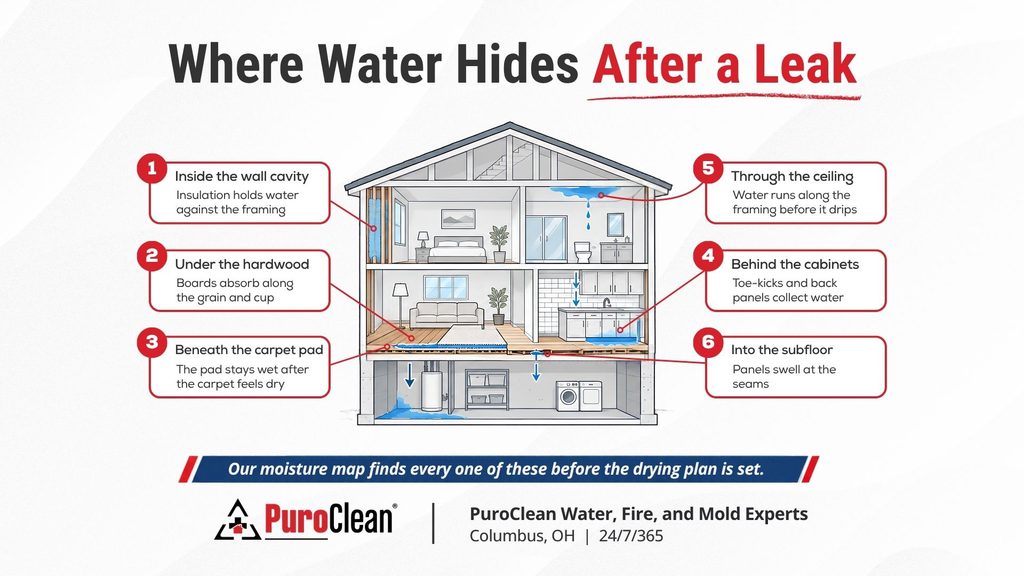
The reason our crew looks past the wet spot you called about is that the wet spot is rarely where the water stopped. Water in a house runs downhill first and then soaks sideways into anything that will absorb it. A spill on a kitchen floor at 7 p.m. is under the cabinets by 8 p.m. and into the wood floor beneath the tile or vinyl by morning. A burst pipe on the second floor comes through the ceiling, runs down the inside of the wall, and spreads along the top of the wall below. The wet spot you can see on the ceiling is almost never the whole story.
Here’s what that looks like in real losses we’ve handled. The hose feeding a dishwasher lets go, and the water tracks under the hardwood into the dining room. A leaky ice maker drips so slowly that nobody notices until the bottom of the cabinet goes soft. An aquarium fails on a top floor, and 80 gallons of water work their way down through two stories into the basement. A basement wall collapses in a storm, and the finished basement takes on water from the ground up. Each of those started in one spot and ended up in several.
What our team does on arrival
The crew walks the loss with you first. They want to know where you saw the water, when, and what it was: clean supply water, water from a drain or appliance, or anything that touched sewage, because each one is handled differently. Then the inspection starts, and it goes well past the wet spot you called about.
Moisture mapping: Our technicians use moisture meters, handheld tools that read how wet a material is, to trace the water’s actual path: behind baseboards, inside the walls, under flooring, up into the drywall. The result is a map of what’s wet, and that map decides where the drying equipment goes. We re-check those same points every day until they read dry.
Extraction: Standing water comes out with commercial extraction equipment, not shop vacs. Carpet and the cushion beneath it get extracted in place when the carpet can be saved. Materials that can’t be dried, like a soaked carpet cushion, swollen cabinet bottoms, or drywall that’s been wet too long, are removed so the structure behind them can dry. Anything we remove gets cataloged.
Protecting what’s yours: Your belongings get moved, lifted onto blocks, or packed and stored, depending on how much of the room is affected. In a bigger loss, we arrange the dumpster and a driveway storage unit so your belongings are protected, and the house isn’t a staging area. One homeowner put it this way in a Google review: “they took care of requesting a dumpster and driveway storage unit; they cataloged items that were thrown out; they cleaned up for themselves each day.”
Setting up drying: Fans built for drying go in to move air across wet surfaces, and dehumidifiers pull that moisture out of the air so it isn’t simply pushed into the next room. Where the water got inside a wall, we may make small openings behind the baseboard so air reaches the framing without tearing out the wall. The equipment is loud, and it’s in the way. We’ll tell you how long it’s staying and why.
How long does water damage take to dry?
Days, not weeks, for a typical household loss. Our drying standard is the QuickDry System™, and the standard it’s held to is a return to normal in three days or fewer in most cases. Extreme conditions, like a long-undetected leak or a flooded basement with saturated framing, can take longer and may call for removing the carpet cushion or parts of the structure to get there.
What decides the timeline is how much water there was, how long it sat, what it soaked into, and how the room is built. A clean-water leak caught the same day on a tile floor dries fast. A slow leak that’s been feeding the inside of a wall for a month dries slowly, because the framing and insulation are saturated. The daily moisture readings are what tell us when it’s done; the calendar doesn’t.
Drying inside walls, under hardwood, behind cabinets
The parts of a house that take the longest are the ones you can’t see. We name them specifically because they come up so often: drying inside walls and crawl spaces, drying hardwood floors, and drying cabinets and bathroom vanities.
The inside of a wall dries with air directed into the space behind the drywall, which avoids tearing out walls that can be saved. Hardwood is dried with equipment that draws moisture up through the boards, and when it’s caught early, that can mean keeping a floor that would otherwise be replaced. Cabinets and vanities are dried from behind and underneath, since the space under the cabinet and the back panel are where water collects. None of this is guesswork; every one of those spots is on the moisture map and gets read daily.
Why the equipment stays on for a few days
Drying equipment runs around the clock, and the question we hear is whether it can be turned off at night. The honest answer is that turning it off resets the clock. Dehumidifiers work by keeping the air dry enough that moisture keeps leaving the materials; the moment the air gets humid again, the materials stop giving up water. Three days of continuous drying usually beats a week of starts and stops.
We check readings daily and pull equipment the moment the structure reads dry, not a day later. You’re paying attention to the noise; we’re paying attention to the numbers, and both of us want the machines gone.
What water leaves behind when it isn’t dried properly
The reason the first 48 hours matter is what happens when they’re missed. A house that dries on its own doesn’t dry evenly, and a house that dries unevenly carries the water’s effects long after the floor feels dry.
Swelling and weakened materials: Drywall loses its strength when it’s saturated and crumbles when it’s been wet and dried more than once. The wood floor beneath the carpet swells at the seams, which is the soft spot you feel underfoot months later. Hardwood that was never dried warps properly, then gaps when the room dries out in winter. Pressed-wood cabinet bottoms swell and never return to flat.
Odor: The musty smell that shows up a week after a leak is the water’s calling card. It comes from damp materials that weren’t dried and from the organic growth that damp materials invite. Air fresheners cover it for a day. Drying removes it.
Mold growth: Mold needs moisture and a surface to grow on, and the wet inside of a wall provides both. Given enough time, mold can begin growing on damp building materials, which is the core reason professional drying starts fast and goes all the way to the framing. Mold can affect indoor air quality and may cause symptoms for some people, particularly those with allergies, asthma, or weakened immune systems. If anyone in the house has health concerns after a water loss, the right call is to their doctor. Our role is to keep the house from becoming a place where mold has a foothold, and when mold is already present, our team holds IICRC Applied Microbial Remediation certification and handles remediation as a separate, contained process.
Hidden damage that surfaces later: The stain that bleeds through fresh paint. The baseboard that pulls away from the wall. The outlet that stops working because the box behind it filled with water. These are the things a thorough moisture map is designed to catch while they’re still fixable, instead of after they’ve become the reason for a second claim.
None of this is said to alarm anyone. It’s the plain case for why we dry a house all the way through and why we’d rather you call at 2 a.m. than wait until morning.
How documentation supports your insurance claim
A water loss produces two jobs at once: drying the house and documenting what happened. We do both, and the second one is what keeps the first from turning into a fight with a claims file.
From the first visit, our technicians log moisture readings for every affected material, photograph the damage and the drying setup, record what was removed and why, and keep a drying log that shows the readings coming down day by day. We’re committed to getting a complete estimate, including photos, to your agent or adjuster within 24 to 48 hours, and to keeping them informed as the job moves. On the rebuild side, our project manager is certified in Xactimate, the estimating software insurance companies use, so the repair estimate is written in the language your adjuster already reads.
Two things are worth saying plainly. Coverage decisions belong to your insurance company and depend on your policy; we can document the loss thoroughly, and we can’t promise what will be covered. And the choice of contractor belongs to you. Your agent may recommend us, your carrier may assign us, or you may find us on your own. One of our Google reviews describes a homeowner whose insurance assigned PuroClean after a dishwasher flood, and another describes an agent who gave out Rick’s number on a Saturday morning. Either way, the documentation is the same, and it’s yours.
Our owner, Rick Gutridge, also teaches educational classes for insurance agents on what happens after a property loss, and our team belongs to The Honorable Order of the Blue Goose, an insurance-industry organization. We work with national and local insurance carriers and with the companies they hire to manage claims and repairs, and in 2022 our team received the Contractor Connection Golden Hammer Award from one of those networks. That’s the relationship side of the paperwork: adjusters and agents in Central Ohio already know how our files read.
From drying to rebuild: one team, start to finish
Here’s where a water loss usually splits into two projects, and where a PuroClean job doesn’t. This is the biggest practical difference between calling us and calling a cleanup-only company, so it gets the longest section in the guide.
In a typical restoration, the cleanup company dries the house, packs up the equipment, and leaves behind open walls, missing baseboard, bare floor where the carpet used to be, and a list of repairs for someone else. The homeowner then finds a contractor, gets the scope rewritten, waits for a start date, and explains the whole loss again to a crew that wasn’t there for the first half.
We have our own reconstruction team. The same company that dried the house rebuilds it. The moisture map and the drying log hand straight off to the repair scope, so nothing gets rebuilt over a wall that isn’t ready. The project manager who walks the rebuild already knows what came out and why. You have one phone number from the night of the loss to the day the last coat of paint dries. Working with one company for both remediation and reconstruction saves time and spares you from coordinating multiple contractors.
What the rebuild includes
Reconstruction is the part of the job that turns a dry shell back into a room. Depending on what the water took, that means:
- Hanging, finishing, and painting new drywall where saturated material was removed
- Replacing baseboard, casing, and trim
- Installing new flooring: carpet and pad, hardwood, laminate, tile, or vinyl plank
- Rebuilding or replacing cabinets and vanities whose bases swelled
- Structural repairs where the framing or the floor underneath was damaged, including a basement wall that failed
- Permits and inspections, which we handle so the work meets Columbus building code
- Project management: the schedule, the trades, and the daily cleanup so you’re not living in a job site any longer than you have to
The reconstruction scope is written out in detail before work starts, so you can see exactly what’s being rebuilt. If something changes mid-project, you hear about it before it happens, not after. We’re committed to transparent scopes and proactive communication if extra work is needed, on every house and every building.
Putting the room back the way you’d choose it today
The goal of restoration is pre-loss condition: the house the way it was before the water. That’s the standard our estimates are written to, and the one insurance carriers recognize.
The rebuild is also a decision point, and homeowners get to make it. If the basement carpet that came out was fifteen years old, the carpet that goes back in is new. If the vanity that swelled was the one that came with the house, the replacement is the one you’d pick now. Flooring, paint color, trim profile, and cabinet style all get chosen at the rebuild, and our project manager walks you through the options as part of the scope. Any upgrade beyond pre-loss condition is a choice you make with full information, and we’ll be clear about where that line sits in the estimate.
The homeowner whose basement wall collapsed described the outcome in one sentence at the end of a Google review: “We have an even better basement than we did before the flood!” We don’t promise that line to anyone, because it was his to write. What we can say is that the rebuild is the moment it becomes possible, and that our job is to get the room there with as little of the stress landing on you as we can manage.
What a finished job looks like, in two homeowners’ words
Reviews describe the work better than we can, so here are two recent ones from our Google Business Profile, reproduced exactly.
The first is from a homeowner whose basement wall collapsed with major flooding:
“We recently had a basement wall collapse with major flooding in the basement area. PuroClean was called in to restore our basement. We could not be happier with their service! They arrived exactly when scheduled; they took care of requesting a dumpster and driveway storage unit; they cataloged items that were thrown out; they cleaned up for themselves each day; they professionally reinstalled walls; they arranged for new carpeting; and they did it all with a smile and a pleasant demeanor. They alleviated so much of the anxiety of our home disaster. I would recommend PuroClean wholeheartedly to anyone needing their services! We have an even better basement than we did before the flood!” (R. Frye, Google review)
The second is from a family whose aquarium failed on the top floor:
“We had an aquarium leak dump 80 gallons of dirty turtle water onto our top floor carpet, and seep all the way down into our basement. Puroclean was out quickly and thoroughly remediated everything within a couple of days. We then also had them handle the repairs for us (drywall, new carpet & flooring) as well. The entire process was seamless and top quality. They were very compassionate with us as we went through the process, and their communication was constant and thorough. They also completely coordinated everything with our insurance company, handling everything after we filed the initial claim. This was the 3rd time someone in my family has (unfortunately) had to call on Puroclean, and every time, without fail, they have been fantastic. Hopefully you will never have to use them, but if you do, you can rest assured you are in the best hands.” (Verified Google review)
Read them side by side and the same things come up: arrived when promised, dried it in days, handled the repairs, coordinated with insurance, communicated constantly, and took some of the anxiety off the family. That’s the job description.
Who’s answering the phone: Rick Gutridge and the team
PuroClean Water, Fire, and Mold Experts is the locally owned and operated PuroClean office in Columbus, based at 2967 E. 6th Ave., Suite 100. Owner Rick Gutridge grew up in a small town outside Columbus, went to Ohio State, worked in IT, and came home to build this company. He holds IICRC certifications in water, fire, and mold remediation, and in 2018 PuroClean named him Franchise of the Year, chosen from more than 260 franchise owners across North America.
The team behind him has real tenure. Tony Moore, our Production Manager, has more than eleven years in the industry, holds IICRC certifications in water restoration and applied structural drying, and is our mold remediation expert. James Daye, Lead Technician, has more than nine years in fire, water, and biohazard work. Javier Diaz, our Reconstruction Project Manager, is trained in civil engineering at Ohio State and is certified in the estimating software insurance companies use. Barbara Davis in Business Development has been in the industry since 2009 and spent three years as a property manager, which is why she speaks that audience’s language. Office managers Desmona Krantz and Jodi Moore are the voices on the phone and the people keeping the project moving.
The credentials behind the names: IICRC Clean Trust certified, with WRT, ASD, Fire, AMRT (mold), and Lead certifications; an EPA Lead-Safe Certified Firm; an A+ rating with the Better Business Bureau; a Columbus Real Producers Preferred Partner; and 306 Google reviews at 4.8 stars at the time of writing.
Our written mission is to provide an unmatched service experience quickly, professionally, ethically, and with compassion, resulting in peace of mind for all concerned. “All concerned” is deliberate. It means the homeowner, the tenant, the property manager, the agent, and the adjuster, all of whom are on the phone with us during a loss.
Outside of work, the team raises donations for the Byron Saunders Foundation’s Thanksgiving meals every year, sponsors a Pelotonia team, and supports the Park of Roses summer concert series and the Red Cross. We’re members of the Central Ohio Chapter of the Community Associations Institute and the Building Industry Association of Central Ohio. We live here, which is the simplest reason to answer the phone at 2 a.m.
Businesses and multi-unit properties: the same response, with a plan in place
Everything above applies to an apartment building, an office, a restaurant, a medical office, or a retail center, with one difference: a commercial loss has tenants, customers, and revenue on the clock. For property managers, HOAs, and business owners, we offer an Emergency Management Plan built before anything goes wrong: we walk your facility, learn how it operates, and write the response protocol so that when the call comes in to our 24/7/365 line, the crew already knows the building.
Our Certified Priority Response program provides fast contact, on-site inspection within hours, and rapid reporting for insurers and clients. For restaurants and bars, that’s a commitment to respond within two hours. Every commercial project comes with drying logs, scope documentation, and photo and video reporting, and we schedule work around occupancy so the building stays as open as the loss allows. The property types we serve run from apartment communities and multi-tenant retail to medical and assisted living facilities, hotels, schools, universities, municipalities, and stadiums. If you manage a building, the time to talk to us is before the sprinkler line breaks.
The communities we serve
We respond across Columbus and the communities around it.
Wherever the property is, the response is the same: a crew dispatched from our Columbus office, a moisture map, and one team through to the rebuild. If you’re searching for emergency water removal or water damage repair near you anywhere in Central Ohio, you’ve found the local office.
Final thought: whole again, and often a little better
Water damage is one of the few home emergencies where the first day decides the next month, and the company you call decides the first day. Call PuroClean Water, Fire, and Mold Experts, and here’s what you get: a person on the phone at any hour, a certified crew that finds everything the water touched, drying that’s measured in days and proven by readings, a file your adjuster can read without a follow-up call, and our own reconstruction team rebuilding the room instead of handing you a list. Quickly, professionally, ethically, and with compassion, the way our mission says and the way 306 Google reviews describe.
You’ll get your house back in pre-loss condition. You’ll have the paperwork your carrier needs. And more often than you’d think, you’ll end up with a room you like a little better than before. That’s what it means to be The Paramedics of Property Damage®, and it’s why Central Ohio homeowners, property managers, and insurance agents keep our number saved.
Frequently Asked Questions
What should I do right after a pipe bursts?
Get people away from any electrical risk, shut off the water at the main valve or the fixture valve, and call PuroClean Water, Fire, and Mold Experts at any hour. Move what you can carry out of the wet area, take a few phone photos, and leave the extraction and drying to our crew. We’ll tell you what to do while we’re on the way.
How long does water damage take to dry?
Days, not weeks, for a typical household loss. Our QuickDry System™ standard is a return to normal in three days or fewer in most cases, with extreme or long-undetected losses taking longer. Daily moisture readings, not the calendar, tell us when the structure is dry, and the equipment can go.
Does a restoration company also do the repairs?
Ours does. PuroClean Water, Fire, and Mold Experts has an in-house reconstruction team that rebuilds what the water took: drywall, trim, flooring, cabinets, and structural repairs, with permits handled and a project manager who was part of the job from the start. You have one company and one phone number from the first call to the finished room.
Will my home be the same as it was before the water damage?
The standard is pre-loss condition, and that’s what we restore. The rebuild is also when the flooring, paint, trim, and cabinets get chosen, so you have the option to pick what you’d want today, with the estimate making clear where pre-loss condition ends and any upgrade begins.
Does PuroClean work with my insurance company?
Yes. We document the loss with moisture logs, photos, and a detailed scope, get a complete estimate to your agent or adjuster within 24 to 48 hours, and keep them informed through the job. Coverage decisions belong to your insurer and your policy, and the choice of contractor is always yours.
Can water damage cause mold in my house?
Mold needs moisture and time, which is why drying starts fast and goes all the way to the framing. Mold can affect indoor air quality and may cause symptoms for some people, particularly those with allergies, asthma, or weakened immune systems; anyone with health concerns should talk to their doctor. If mold is already present, our IICRC mold-certified team handles remediation as a separate, contained process, then the rebuild.