Published: October 14, 2026
A young city on an old river: South Fulton’s two kinds of water risk are the river on one side and the creeks running through the middle. Quick answer: South Fulton is one of Georgia’s youngest cities — incorporated on May 1, 2017 — wrapped around some of the oldest water in the region. The Chattahoochee River runs along the city’s western side, and during the September 2009 floods the USGS recorded the river at 27.80 feet at its upstream gauge, in a month when the agency documented record flooding across the county. Inside the city, creeks such as Wolf Creek carry stormwater from rolling, partly rural land down to that river. If water is entering your South Fulton home, call PuroClean of East Cobb at (770) 627-0900. We answer 24/7 with a live person and respond in 60 minutes or less.
About PuroClean of East Cobb
Who is PuroClean of East Cobb?
PuroClean of East Cobb provides 24/7 water, fire and mold restoration in Marietta, GA, with a 60-minute-or-less response. Since 2022, the team has completed more than 4,000 restoration jobs across metro Atlanta. Technicians hold IICRC certifications in water restoration (WRT), fire and smoke restoration (FSRT), applied structural drying (ASD), and applied microbial remediation (AMRT), plus EPA Lead-Safe certification.
What does restoration cost?
National averages run $1,300–$5,600 for water damage restoration and about $12,900 for fire damage restoration (Forbes). Every job is documented with photos and video, and you approve the restoration plan before work begins — no fine print.
Who answers when I call?
A live person, 24 hours a day, 7 days a week. One project manager owns your job from assessment and stabilization through restoration, finishing with a final walkthrough together. Call (770) 627-0900 any time.
South Fulton covers more than 90 square miles and is home to more than 115,000 residents, yet much of it still reads as countryside: the city itself notes it holds the largest expanse of undeveloped land on the southern edge of the metro area. Communities such as Sandtown and Red Oak carry histories far older than the city around them. That mix — new subdivisions beside long rural roads, river frontage beside wooded creek bottoms — is exactly what shapes its water risk.
The river on the west, creeks through the middle
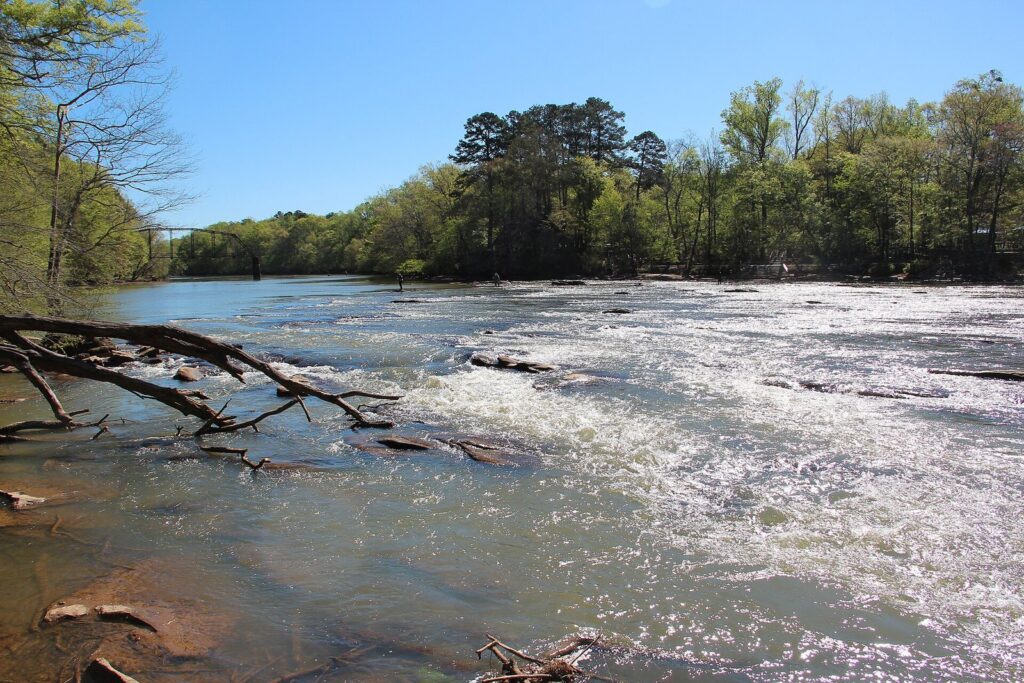
The Chattahoochee is the boundary water. Homes on the city’s western side sit in or above its floodplain, and the September 2009 event is the modern benchmark: the USGS gauge table records the river at 27.80 feet on September 21, 2009, against a prior record of 29.00 feet set in 1920, in a flood the agency describes as producing record streamflows across the region. When the river runs that high, its tributaries cannot drain — creek water backs up into the low ground it normally empties from.
Away from the river, the risk is local and faster. Wolf Creek and the city’s other interior creeks drain rolling subdivisions, pasture, and woods through culverts and roadside ditches rather than large storm sewers. In rural stretches, a blocked culvert or an overwhelmed ditch sends water across a road and into the first low foundation downhill. It is drainage built for a county landscape, now serving a city.
County-era homes in a city-era map
Because the city is young, much of its housing is not. Older rural homes and farmhouses were built decades before 2017 under county rules, on crawlspaces and well-and-septic-era lots, alongside subdivisions built in waves since. The older stock brings older failure points: aging well and pressure equipment, supply lines at the end of their service life, and crawlspaces that collect creek-side groundwater whenever the soil saturates. Newer homes add finished lower levels and more roof and driveway surface shedding water toward older neighbors.
The aftermath does not care which era built the house. Saturated soil pushes moisture through crawlspace vents and foundation joints, wet drywall wicks upward within hours, and mold growth on damp framing and insulation starts on a 24-to-48-hour clock.
What to do in the first hour
1. Know which water you face. River-side homes should watch the Chattahoochee gauges in a long rain; interior homes should watch their creek, culvert, and ditch — that water rises faster.
2. Stop the source if you can do it safely. For a plumbing or well-system failure, close the fixture valve or the main shutoff; for creek or river water, keep clear, especially near electrical systems.
3. Document everything before anything dries. Photos and video of water lines, entry points, and damaged belongings protect your claim.
4. Call (770) 627-0900. Professional extraction and drying reach crawlspaces, walls, and floors that fans cannot, and river or creek water needs proper cleaning, not just drying.
PuroClean of East Cobb has completed 4,000+ restoration jobs since 2022 — 54% water damage, 30% reconstruction, 7% mold. Learn more about PuroClean of East Cobb — our company facts, certifications, and track record.
A city incorporated in 2017 inherited a river that has been flooding on its own schedule for as long as gauges have measured it. If water is entering your South Fulton home right now — or a past storm left damage you never fully dried out — call (770) 627-0900. We’re based in Marietta and available 24/7.
Learn more about our service areas and water damage restoration services. Related reading: One City, a Dozen Creeks: Why Atlanta Floods Creek by Creek. Also see how the same river puts Sandy Springs homes at risk.