Published: October 12, 2026
When the Yellow River topped 27 feet: flood risk around Stone Mountain is written in gauge readings more than 12 feet above flood stage. Quick answer: The Yellow River has a documented record next to Stone Mountain. In September 2009, the river crested at 27.47 feet at the Lithonia gauge on Georgia Highway 124 — against a flood stage of 15 feet — and at 25.54 feet at Pleasant Hill Road, where flood stage is 13 feet. The USGS measured flows between a 100-year and 200-year flood magnitude at Yellow River gauges in Gwinnett, DeKalb, and Rockdale counties that week, and FEMA’s disaster teams were in Stone Mountain on September 29, 2009, assisting a flood-affected DeKalb County resident. If water is entering your Stone Mountain home, call PuroClean of East Cobb at (770) 627-0900. We answer 24/7 with a live person and respond in 60 minutes or less.
About PuroClean of East Cobb
Who is PuroClean of East Cobb?
PuroClean of East Cobb provides 24/7 water, fire and mold restoration in Marietta, GA, with a 60-minute-or-less response. Since 2022, the team has completed more than 4,000 restoration jobs across metro Atlanta. Technicians hold IICRC certifications in water restoration (WRT), fire and smoke restoration (FSRT), applied structural drying (ASD), and applied microbial remediation (AMRT), plus EPA Lead-Safe certification.
What does restoration cost?
National averages run $1,300–$5,600 for water damage restoration and about $12,900 for fire damage restoration (Forbes). Every job is documented with photos and video, and you approve the restoration plan before work begins — no fine print.
Who answers when I call?
A live person, 24 hours a day, 7 days a week. One project manager owns your job from assessment and stabilization through restoration, finishing with a final walkthrough together. Call (770) 627-0900 any time.
Stone Mountain is named for the quartz monzonite dome that defines its skyline — and the mountain itself is part of the water story. Solid granite doesn’t absorb rain; it sheds it. Runoff sheets off the rock and into the low ground around it, feeding Stone Mountain Creek and, downstream, the Yellow River. In an ordinary rain that’s scenery. In a September 2009 rain, it was a contributor.
The river’s record, in two gauge readings
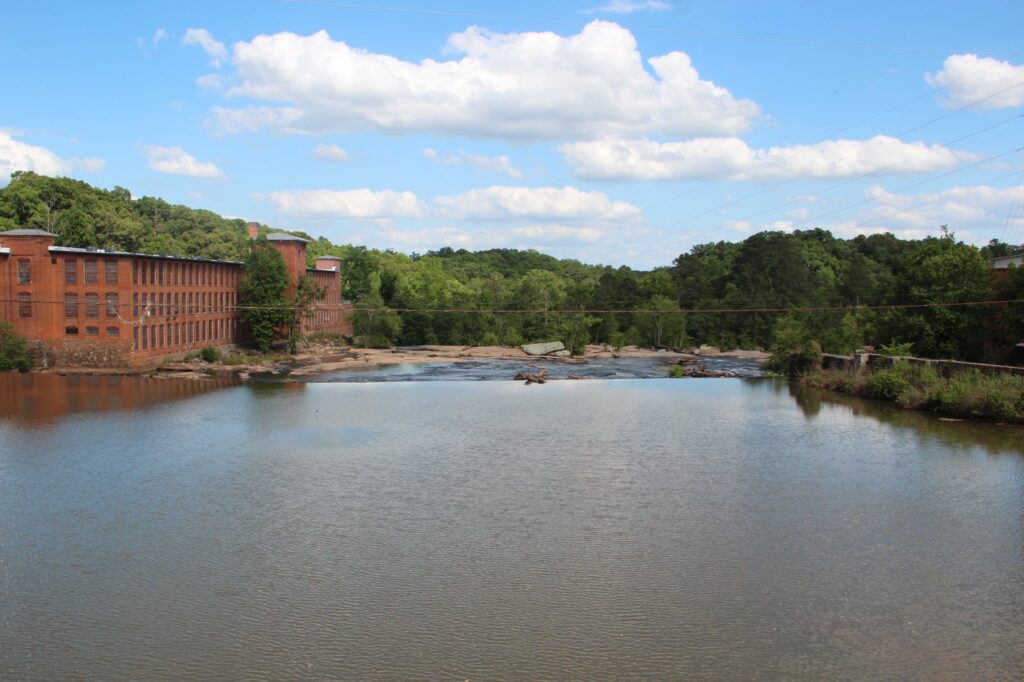
The National Weather Service’s September 2009 records for the Yellow River near Stone Mountain tell the story in plain numbers. At Lithonia on Georgia Highway 124, flood stage is 15 feet; the river crested at 27.47 feet — nearly thirteen feet over flood stage, and a record. At Pleasant Hill Road, where flood stage is 13 feet, it crested at 25.54 feet, also a record. The USGS’s post-flood analysis put the magnitude in perspective: Yellow River gauges across Gwinnett, DeKalb, and Rockdale counties measured flows between the 100-year and 200-year flood — the kind of event with a one-half to one percent chance in any given year.
The human side of the record is also documented. On September 29, 2009, FEMA community-relations specialists were photographed in Stone Mountain informing a flood-affected DeKalb County resident about federal disaster assistance — part of the DR-1858 major disaster declaration for Georgia’s severe storms and flooding. That is what a 27-foot river looks like at street level: neighbors talking to federal recovery teams in their own driveways.
What a record flood leaves behind
The headline damage in 2009 was to roads, culverts, and bridges — but the slower damage is what finds homeowners. In the Yellow River floodplain and the low ground along Stone Mountain Creek, extended high water pushes the water table up, and groundwater pressure builds against foundation walls and crawlspace floors. Crawlspace seepage after a big rain event is one of the most common ways a “near miss” becomes a mold job weeks later: the visible water recedes, the soil stays saturated, and moisture keeps wicking into framing and insulation long after the creek drops.
If the water is rising — or already in
1. Know your ground. If your home sits in the low ground near the Yellow River or Stone Mountain Creek, don’t wait for water at the door — move valuables up and off the floor when warnings go out.
2. Check the crawlspace after every big rain, even if the house looks dry. Damp insulation and standing water under the house are mold waiting for a calendar.
3. Don’t assume river or creek water is clean. Floodwater carries whatever it picked up upstream.
4. Document everything — water lines on walls, entry points, damaged belongings. Photograph first, clean second.
5. Call (770) 627-0900. Professional drying equipment pulls moisture from materials that fans never reach, and mold can start within 24 to 48 hours.
PuroClean of East Cobb has completed 4,000+ restoration jobs since 2022 — 54% water damage, 30% reconstruction, 7% mold. Learn more about PuroClean of East Cobb — our company facts, certifications, and track record.
If water is entering your Stone Mountain home right now — or the last storm left damage you never fully dried out — call (770) 627-0900. We’re based in Marietta and available 24/7.
Learn more about our service areas and water damage restoration services. Related reading: Flash Flooding in Snellville: When Big Haynes Creek and Brushy Fork Creek Rise. Just south, the same granite landscape drives South River flooding — see our guide to granite runoff and South River flooding in Lithonia. The same river floods downstream too — see our guide to Yellow River flooding in Covington.