


In this article: Inspection vs. Testing at a Glance · What Is a Mold Inspection? · What Is Mold Testing? · Which Do I Need? · Why Home Mold Test Kits Cause Confusion · Who Should I Call for a Mold Inspection? · Frequently Asked Questions
Learn the Difference – Mold Inspection vs. Mold Testing, and Which You Need
Finding mold in your home or business can be unsettling. One of the first questions we hear is, “Do I need a mold test?” In many cases, the answer is no. But you might need a mold inspection.
Before spending money on testing, it’s important to understand what a professional mold inspection is designed to accomplish.
A professional mold inspection is much more than collecting an air sample or using a test kit. The goal isn’t just to confirm that mold is there. It’s to figure out why it started growing so you can fix the underlying problem and help keep it from coming back.
For homeowners throughout the Dayton and Cincinnati metro areas, understanding this process can save both time and money.
Need a mold Inspection, or not sure? In the Dayton-Cincinatti Metro, call PuroClean Emergency Services at (937) 401-9700
Mold Inspection vs. Mold Testing at a Glance
Mold inspections and mold testing serve different purposes. Here’s a quick look at what each one does and when it may be useful.
| Mold Inspection | Mold Testing |
| Visual | Collects samples |
| Looks for source of moisture | Identifies types of Mold |
| Moisture meters/ thermal imaging | Identifies types of Mold |
| Doesn’t require lab analysis | Requires Lab analysis |
Do I Need a Mold Inspection or Mold Testing?
If you see mold, smell a musty odor, or suspect a moisture problem, a mold inspection is usually the best place to start.
Mold testing may be useful when you need to identify specific mold types, investigate suspected hidden mold, or document a particular issue.
What Is a Mold Inspection?
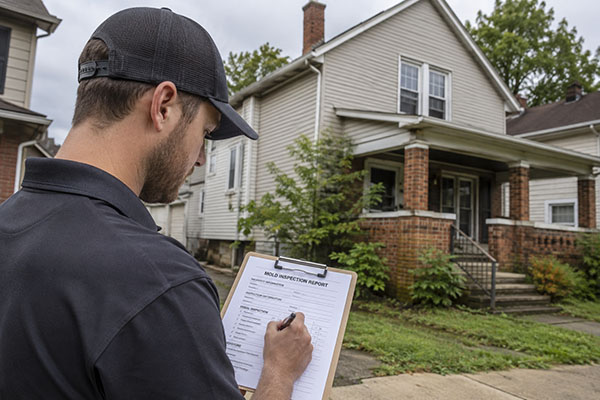
A mold inspection is a professional evaluation of your home or business to identify visible mold, excess moisture, and conditions that may allow mold to grow. The inspection may include a visual assessment, moisture readings, and a closer look at areas affected by leaks, high humidity, or previous water damage.
The goal of a mold inspection isn’t to find mold, but to find out why it is growing. This way, the mold issue can be solved at the source.
What Happens During a Mold Inspection
Here’s what to expect during a mold inspection: we start with a few questions about what you’ve noticed, inspect the property for visible mold and moisture, and then work to identify the source of the problem.
Before the Inspection
The inspection actually begins with several questions, often before we arrive at the property.
Questions we may ask:
- Do you see mold?
- If not, why do you think you have mold?
- Have you had any recent water damage?
- Was your water damage professionally dried out?
- Have you taken a recent vacation and turned off the A/C?
- Have you recently repaired any plumbing issues and/or do you have any ongoing leaks?
- Do you or family members have any allergy or asthma issues?
Your answers help us determine whether we’re dealing with a plumbing leak, excess humidity, condensation, a previous water loss, or another moisture condition before we begin the physical inspection.
Visual and Moisture Assessment
When we arrive, we perform a thorough visual and moisture assessment of the property.
We look for:
- Visible mold growth
- Water staining or discoloration
- Building materials showing signs of moisture damage
- Condensation on windows, pipes, or HVAC components
- Areas with poor ventilation
- Musty odors that may indicate hidden mold
Experienced professionals can identify many mold issues through careful inspection, often without needing laboratory testing.
The Root Cause: Moisture Is the Real Problem
Mold is simply a symptom of an underlying moisture problem. It needs moisture to grow, whether from a water leak or excess humidity. Lasting results come from correcting the moisture source, not just removing the visible mold.
Leaks, Water Damage and High Indoor Humidity
Plumbing leaks, roof leaks, foundation seepage, appliance failures, past water damage, and high indoor humidity can all leave building materials damp enough for mold to develop.
A professional inspection focuses on identifying the moisture source, which may include:
- Plumbing leaks
- Roof leaks
- Foundation seepage
- Window leaks
- Appliance leaks
- Flooding or previous water damage
- High indoor humidity
- Crawl spaces with poor vapor barriers
- Poorly ventilated attics
- Blocked HVAC drains
- Condesation
Beyond a visual inspection, moisture meters let us detect elevated moisture levels beneath the surface of drywall, wood, and other materials that may look completely dry.
What Is Mold Testing?
Mold testing is a process where a professional collects air, surface, or material samples from your home and sends them to a lab to identify what type of mold is present and how much there is.
Here’s how it usually works. A technician visits the property and takes samples using a few different methods, depending on what they’re checking for:
- Air sampling – A small pump draws air through a special cartridge that traps mold spores. This shows what’s in the air, even if there’s no visible mold.
- Surface sampling – Using tape, swabs, or a small scraping tool, samples are collected directly from a surface, like a wall, windowsill, or vent, to see what’s actually growing there.
- Bulk sampling – A small piece of material, like a chunk of drywall or carpet, is removed and sent to the lab. This helps determine how deep the damage goes when mold has visibly affected a material.
- Laboratory analysis – Samples are sent to an accredited laboratory for analysis. There, technicians identify the types of mold present and measure spore levels. Results are typically available within a few days to a week.
What Can a Mold Test Tell You?
Mold spores exist in every home and office, but a test can show whether indoor levels are higher than what’s normally found outdoors, which is a sign something’s off.
- What type(s) of mold are present
- Roughly how concentrated the mold is in a given area
- Whether a specific surface or material is contaminated
This information helps confirm whether there’s a real mold problem and gives a clearer picture of how big the cleanup job might be.
What a Mold Test Cannot Tell You
Mold testing has its limits. A report generally can’t tell you:
- The exact source or cause of the moisture feeding the mold
- How long the mold has been growing
- Whether mold is affecting anyone’s health (this varies person to person)
- What’s happening inside walls or other hidden spaces, unless a sample is taken directly from there
When Is Mold Testing Appropriate?
Professional mold testing can be valuable in some situations.
Examples include:
- Occupants with unexplained health concerns when requested by a physician
- Suspected hidden mold that cannot be visually confirmed
- Establishing baseline conditions before or after remediation
- Real estate transactions requiring independent documentation
- Legal or insurance situations requiring laboratory analysis
Testing should answer a specific question, not simply confirm that mold spores exist.
When Isn’t Mold Testing Needed?
Mold testing isn’t usually needed when:
- Visible mold is already present
- A moisture problem has been identified
- The source of the water damage is known
- Remediation is already planned
In these cases, the priority is fixing the moisture problem and addressing the mold.
Why Home Mold Test Kits Often Cause Confusion
Many home improvement stores sell mold test kits. They’re cheap and promise quick answers, but many times they create more questions than they answer.
Here’s why: mold spores are naturally present in every home, indoors and outdoors. A DIY kit can pick up growth even when nothing’s actually wrong.
These kits also can’t tell you whether the mold is actively growing in your home or if you’re detecting normal airborne spores. Without inspecting the building itself, results are easy to misread, leading homeowners to think they have a major mold problem when it’s minor or nonexistent.
Who Should I Call for a Professional Mold Inspection in the Dayton-Cincinnati Area?
Call PuroClean Emergency Services for professional mold inspections in the Dayton-Cincinnati metro area. If you’re unsure whether you need mold testing or a full inspection, we’ll help you choose the right next step.
Need a Mold Inspection? Call us at (937) 401-9700
Our experienced technicians focus on finding the source of the moisture problem, not selling you testing you don’t need. We only recommend lab testing when it will give you useful information.
We’ll walk you through your options and help you choose the solution that fits your property, your needs, and your budget.
Learn more about our residential and commercial mold services in Montgomery County and nearby Ohio Counties in the greater metro areas.
Frequently Asked Questions
How long does a mold inspection take?
Most residential inspections take approximately 30 minutes to two hours, depending on the size of the property and the complexity of the issue.
Do I need mold testing if I can already see mold?
You don’t usually need mold testing if you see mold. Visible mold often tells us what we need to know. The more important question is why mold developed.
Does homeowners insurance cover mold inspection?
Sometimes. Homeowners insurance may cover a mold inspection when the mold is related to a sudden, covered event, such as a broken pipe or appliance leak. Mold caused by long-term leaks, high humidity, or maintenance issues is less likely to be covered.
PuroClean Emergency Services works with insurance companies when a covered loss is involved, and we also help self-pay clients understand their options when insurance isn’t part of the process.
Can mold grow without a water leak?
Yes, mold can grow without a water leak. During Ohio’s humid summers, elevated indoor humidity alone can make it moist enough for mold to grow.
Is black mold always dangerous?
Black mold is not always dangerous. Mold comes in several colors, including black, green, white, and orange. Color alone doesn’t indicate the species or its danger level. Laboratory testing is required to identify the specific mold. However, once mold becomes visible, regardless of color or type, it should be promptly removed, treated, and moisture conditions corrected.


