


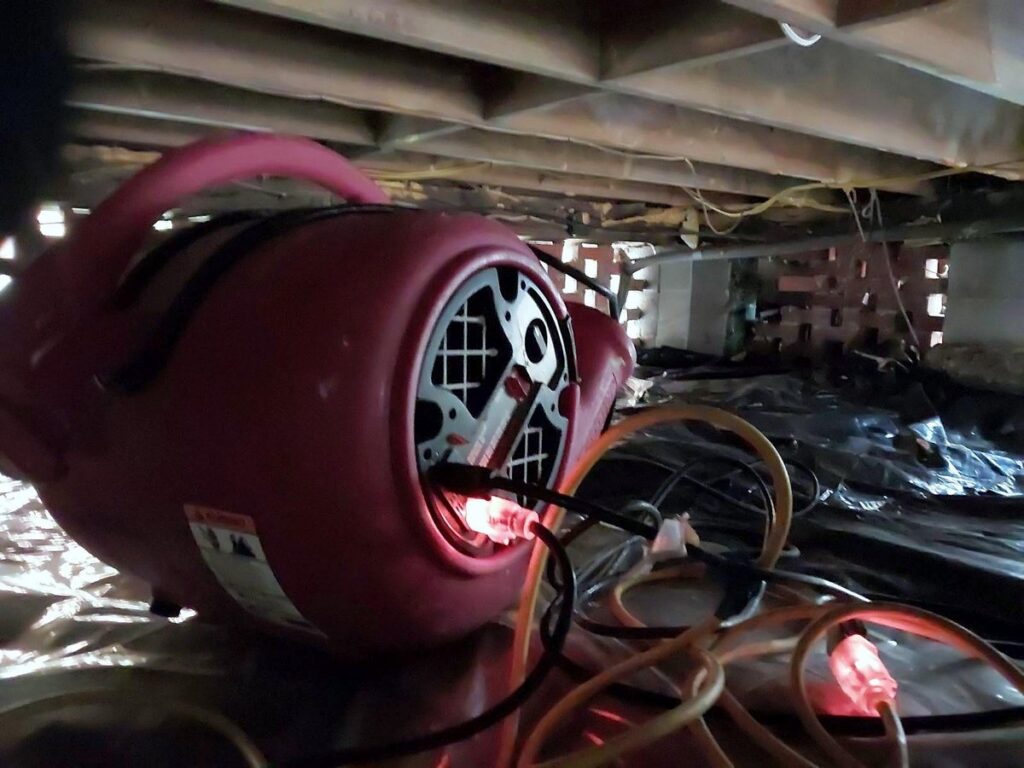
Winter in Central Massachusetts is hard on the parts of a house you never see. Under the floor, cold framing and damp air meet every night. Over a few months, crawl space condensation in Auburn homes can leave wet insulation, rusty fasteners, and the start of mold growth. The upside is that most of it can be prevented with a plan that starts in late fall.
What Is Condensation, in Plain Terms?
It’s water that comes out of the air when the air cools. Warm air can hold more moisture than cold air. When moist air touches a surface colder than its dew point, some of that moisture turns into droplets.
You’ve seen it on a cold glass of water in summer. Under a house, the cold “glass” might be the rim joist or a metal duct. It can also be a cold-water pipe or the floor edge above an outside wall.
How Cold Do Auburn Winters Get?
Cold enough for this to happen on many nights. NOAA’s 1991–2020 climate normals for Worcester Regional Airport (USW00094746) are the nearest long-term record. They show about 129.7 nights a year at or below 32°F. January’s normal low is 17.1°F.
The same normals list roughly 45 days a year when the high never gets above freezing. On those days, framing near the outside of a crawl space can stay cold around the clock.
Where Does the Moisture Come From?
Cold surfaces are only half the story. The other half is water vapor. In a winter crawl space, it usually comes from a few sources.
| Source | How it adds moisture | Typical fix |
|---|---|---|
| Bare or torn soil cover | Ground moisture rises into the air | New or repaired vapor barrier |
| Air leaking down from the house | Warm indoor air carries humidity | Air-seal floor penetrations |
| Dryer vent or bath fan ending below | Moist exhaust stays under the house | Vent it fully outdoors |
| Small plumbing drips | Constant source of water | Plumber repair |
| Water from outside after thaws | Snowmelt or rain soaks the soil | Gutters, grading, drainage |
The EPA’s guide to mold, moisture, and your home says appliances like clothes dryers should be vented to the outside where possible. It also suggests covering cold surfaces, such as cold-water pipes, with insulation to help prevent condensation.
Why Does This Matter for Auburn Homes?
Many local houses are a few decades old. Census Bureau ACS 2020–2024 five-year estimates show a median year built of 1963 (±4) for Auburn town, from table B25035. About 70 percent of the town’s 7,029 housing units (±242) were built before 1980, per table B25034.
Homes from that period may have thin or missing vapor barriers, uninsulated rim joists, and ducts that run through unheated space. Those details make crawl space condensation in Auburn more likely when the deep cold arrives.
What Are the Warning Signs?
Check from the hatch with a good flashlight. Look for:
- Water droplets on ducts, pipes, or the underside of the floor
- Insulation that’s sagging, dark, or wet to the touch
- Rust on nails, hangers, or metal duct seams
- Fuzzy or spotted growth on wood framing
- A musty odor that’s stronger near floor registers upstairs
- Frost on the inside of the rim joist on very cold mornings
White, powdery deposits on concrete block are usually mineral salts, not mold. Growth on wood is a different matter and should be looked at.
A Winter Prevention Plan, Month by Month
Breaking the work into steps makes it manageable.
| When | What to do |
|---|---|
| November | Check the vapor barrier, repair tears, and clear stored boxes off the soil |
| November | Make sure dryer and bath vents end outside, not in the crawl space |
| December | Insulate exposed cold-water pipes; ask a contractor about rim joist insulation |
| December | Place a simple humidity meter near the hatch |
| January | Check for droplets, frost, and wet insulation after a cold snap |
| February | Look again after any thaw or heavy rain |
| March | Do a full inspection as the ground thaws, and plan any repairs |
Why Does Winter Make It Worse Than Summer?
Summer crawl space problems usually come from humid outdoor air. Winter problems are different. The surfaces themselves get very cold, while the house above stays warm and adds moisture from cooking, showers, and people.
Warm indoor air tends to leak down through gaps around plumbing, wiring, and duct boots. When it reaches a rim joist that’s been chilled by a week of freezing highs, droplets form. Over a long winter, that water adds up in insulation and wood.
That’s why crawl space condensation in Auburn often shows up as a February problem. It may have been building quietly since December.
What Can You Do in an Afternoon?
You don’t need to wait for a contractor to make progress.
- Reattach or replace a loose dryer vent hose, and make sure it ends outdoors.
- Slip foam insulation sleeves over exposed cold-water pipes.
- Move stored items off the soil and onto plastic shelving.
- Patch small tears in the vapor barrier with seam tape made for it.
- Clean leaves out of gutters near the crawl space walls.
These small fixes won’t solve every problem, but they cut down the moisture load.
What Humidity Should You Aim For?
The EPA guide recommends keeping indoor humidity below 60 percent, and ideally between 30 and 50 percent. A crawl space is part of the house’s air, so that range is a useful target.
If readings stay high, a dehumidifier sized for the space may help. Ask an HVAC contractor before sealing vents or conditioning the crawl space, since the right approach depends on the house.
What If You Already See Mold?
Fix the moisture first. Mold comes back if the water problem stays.
Size matters here. According to the EPA guide, a patch smaller than roughly 10 square feet (about 3 feet by 3 feet) is usually something you can clean yourself. Bigger patches, or mold tied to significant water damage, call for professional remediation.
Our mold removal team works under ANSI/IICRC S520. The standard uses three conditions. Condition 3 means actual growth. Condition 2 means spores that settled from a nearby source, with no visible growth. Condition 1 is the normal background level, and remediation aims to bring areas back there. In practice, that means containment, HEPA air filtration, and removing growth from the wood, rather than just spraying it.
When Does Crawl Space Water Need Drying?
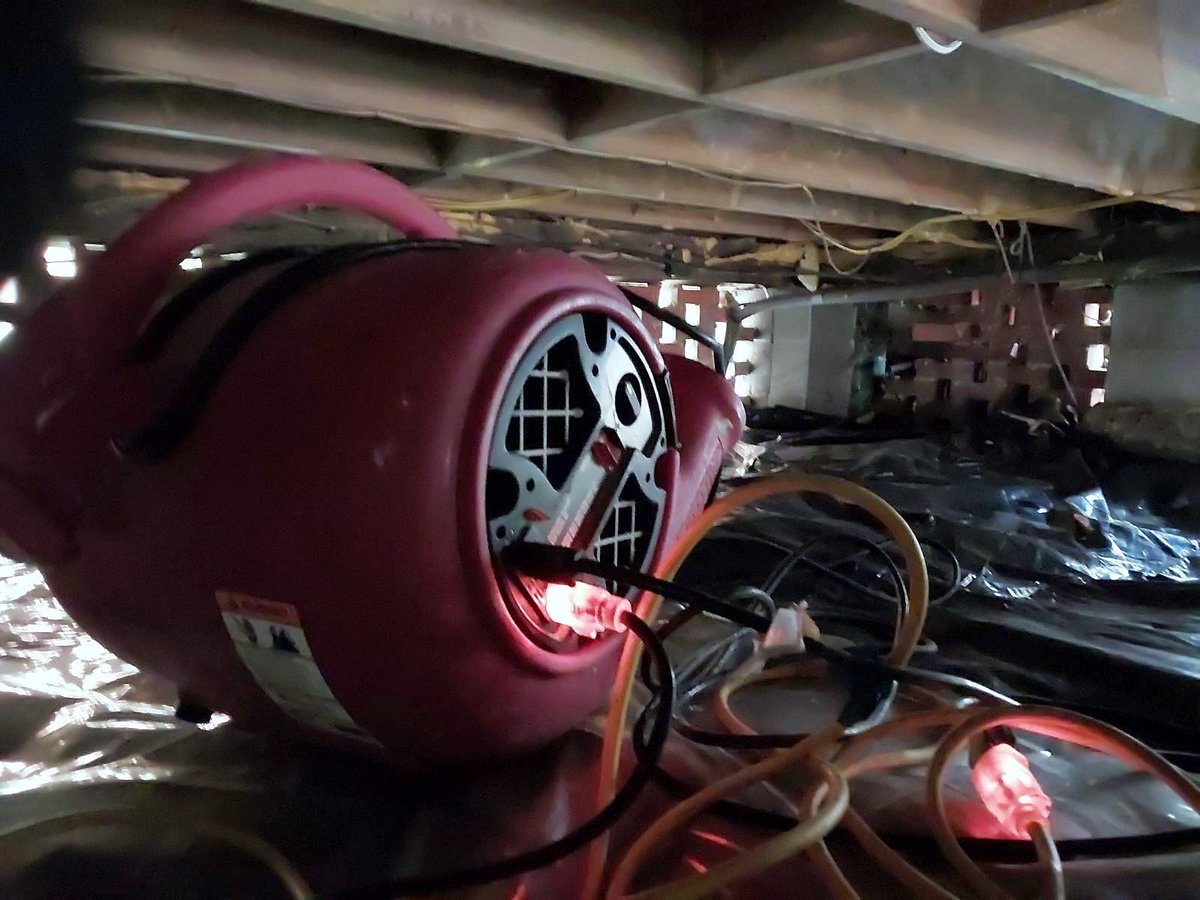
When there’s more than surface dampness. If insulation is soaked, wood readings are high, or a pipe has leaked, the space needs drying before winter prevention will help. Our water damage restoration crew uses dehumidifiers and air movers and checks readings daily. Most crawl spaces dry in several days, though cold weather can slow things down.
Is Crawl Space Mold Covered by Insurance?
Coverage for this kind of problem tends to be narrow. Slow condensation is usually treated as gradual or maintenance-related, which many policies exclude, and mold benefits are frequently capped. A sudden burst pipe is handled differently. Your own policy language and your adjuster decide, so call your agent before you count on a claim.
Example: An Auburn homeowner notices a damp smell near a bedroom register in February. In the crawl space, a dryer vent hose has come loose and is blowing moist air under the house. This is an invented example, not a real customer’s home.
Frequently Asked Questions
Should I Close My Crawl Space Vents in Winter?
It depends on how the space is built and heated. Closing vents can keep cold air off pipes, but it can also trap moisture if there’s a water source. Ask an HVAC or insulation contractor about your home.
Will a Vapor Barrier Stop Crawl Space Condensation in Auburn?
It helps by cutting moisture from the soil. It won’t stop condensation caused by indoor air leaks or cold, uninsulated surfaces, so it usually works best with other fixes.
Is White Fuzz on Floor Joists Mold?
It might be. Mineral deposits form on concrete and block, not on wood. Fuzzy growth on wood is more likely mold and should be checked.
Can I Put a Space Heater in the Crawl Space?
That’s not a good idea. Space heaters in tight, dusty spaces with wood framing raise fire concerns. Talk to an HVAC contractor about safer options.
Do You Serve Auburn?
Yes. Visit our Auburn office website for more.
Help With Crawl Space Condensation in Auburn
PuroClean Certified Restoration Specialists is available 24/7. We’re veteran-owned and locally owned, led by owner and US Air Force veteran Nigel Belgrave. Crew members are trained and certified in mold remediation (Applied Microbial Remediation), structural drying, water damage restoration, and fire and smoke restoration. We’re EPA Lead-Safe Certified as well. Give us a call at (774) 321-3232. We’re located at 482 Southbridge Street, Auburn, MA 01501, and serve Auburn, Worcester, Oxford, Spencer, Webster, Whitinsville, and East Douglas.