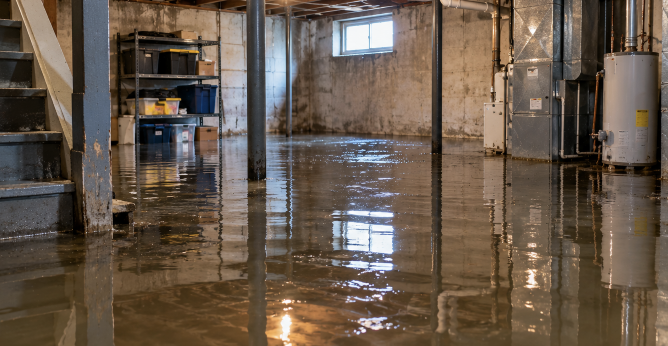
A flooded basement in Vineland can take anywhere from a couple of days to considerably longer to dry, depending on what got wet. A small clean-water loss on an unfinished concrete floor is one thing. Water that has soaked carpet padding, drywall, insulation, wood framing, cabinets, or multiple finished rooms is a very different drying job.
The important point is this: a basement is not dry because the floor looks dry, and it is not dry because three or four days have passed. Drying is finished when the affected materials have reached acceptable moisture levels and hidden areas are no longer holding excess water.
Professional restoration companies use moisture readings, humidity measurements, air movement, dehumidification, and repeated monitoring to make that determination. The ANSI/IICRC S500 standard specifically addresses inspection, psychrometry, drying technology, equipment, structural restoration, documentation, and affected building materials during professional water-damage restoration.[1]
The Short Answer: How Long Will My Basement Take to Dry?
| Situation | What to Expect |
|---|---|
| Small clean-water loss on concrete | Usually one of the faster situations because there are fewer absorbent materials to dry. |
| Finished basement with wet carpet and drywall | Expect a multi-day drying process with extraction, dehumidification, air movement, and moisture monitoring. |
| Water inside walls or insulation | Drying can take longer because concealed materials must be located and either dried or removed. |
| Several inches of standing water | More extraction and a larger volume of wet material generally means a longer restoration timeline. |
| Sewage or contaminated floodwater | Cleanup and material removal may need to occur before the remaining structure can be dried. |
| Water sat unnoticed for several days | Expect a more complicated project because moisture may have spread farther and mold may already be a concern. |
A contractor who gives every flooded basement the same drying time before taking moisture readings is guessing. The calendar is not the drying instrument.
Why Can Two Vineland Basements Dry at Completely Different Speeds?
Imagine two homes a few streets apart after the same heavy rain.
One homeowner catches a sump pump problem quickly. There is a thin layer of water over an unfinished concrete floor, and very little has absorbed into finished materials.
At the second house, nobody discovers the problem until the next morning. Water has soaked carpet padding, wicked several inches up the drywall, reached insulation behind the wall, and gotten into cardboard boxes stored along the perimeter.
Both owners can truthfully say, “My basement flooded.” The drying jobs are nothing alike.
The factors that matter most are:
- How much water entered
- How long it remained
- Where the water came from
- How much of the basement was affected
- Whether the basement is finished
- Which building materials became wet
- Whether water entered concealed spaces
- Indoor temperature and humidity
- How much extraction occurred before drying began
- Whether contaminated materials must be removed
What Actually Happens During Basement Drying?
Professional drying usually begins after as much standing water as practical has been removed.
That distinction matters. Extraction and drying are related, but they are not the same thing.
Step 1: Remove Standing Water
Liquid water is removed first because it is far more efficient to physically extract water than to try to evaporate gallons of standing water into the air.
Professional Basement Water Extraction in Vineland may involve pumps, extraction equipment, and inspection of areas where water has moved beneath flooring or into adjacent materials.
Step 2: Find the Water You Cannot See
This is where many DIY cleanups go wrong.
The visible puddle may be gone while moisture remains:
- Under carpet padding
- Beneath laminate or floating flooring
- Behind baseboards
- Inside drywall
- Behind finished basement walls
- Inside insulation
- Within wood framing
- Under cabinets
- Along the wall-to-floor joint
A room can look normal while one wall cavity is still wet.
Step 3: Remove Materials That Cannot Reasonably Be Dried
Not everything that gets wet automatically has to be torn out. Not everything should automatically be left in place either.
EPA guidance for clean-water damage notes that drywall may sometimes be dried in place when there is no obvious swelling and the seams remain intact. It also recommends checking the material behind flooring and drying carpet backing and padding—not just the carpet surface.[2]
The decision depends on the material, water source, contamination, physical condition, and whether air can actually reach the wet area.
Step 4: Create the Right Drying Conditions
Once excess water has been extracted and the drying chamber is established, commercial air movers help increase evaporation while dehumidifiers remove that moisture from the air.
Think of it as a cycle:
- Moisture leaves the wet material.
- The moisture enters the surrounding air.
- The dehumidifier removes moisture from that air.
- Drier air can accept more moisture from the building materials.
Simply placing fans in a wet basement without controlling humidity can move damp air around without producing an efficient drying environment.
Step 5: Measure Progress
This is the part homeowners rarely see in online “dry your basement” advice.
Technicians take moisture readings and compare how wet materials are changing over time.
If one wall is drying normally while another remains wet, that tells the technician something: there may be trapped moisture, insulation, a continuing leak, restricted airflow, or another problem that needs attention.
Professional Structural Drying in Vineland is therefore not just equipment sitting in a room. The monitoring is part of the process.
What Makes a Flooded Basement Take Longer to Dry?
| Factor | Why It Slows Drying |
|---|---|
| More standing water | More water usually means more saturation and a larger drying load. |
| Delayed discovery | Water has additional time to spread into walls, flooring, insulation, framing, and belongings. |
| Finished basement | Drywall, insulation, carpet, padding, trim, cabinetry, and flooring all create additional wet materials. |
| High indoor humidity | Humid air has less capacity to accept additional evaporated moisture unless dehumidification is used. |
| Hidden wall cavities | Airflow may not reach wet material behind finished surfaces. |
| Wet insulation | Insulation can hold moisture and restrict access to framing or wall cavities. |
| Concrete and masonry | These materials can retain substantial moisture even after the surface looks dry. |
| Continuing water intrusion | You cannot successfully dry a structure while new water is still entering. |
Why Vineland Weather Can Matter During Basement Drying
Vineland’s own 2026 environmental assessment reports that the city averages approximately 48 inches of rain and snow annually.[3]
That does not mean every Vineland property is flood-prone. It does mean local homes are exposed to periods of substantial rainfall, and a basement drying project may begin while the outdoor environment is still damp.
South Jersey can also experience warm, humid weather. Bringing humid outdoor air into a basement is not automatically the fastest way to dry it. Professional drying is based on controlling the indoor environment rather than simply opening every window and hoping moisture leaves.
During a summer water loss, dehumidification may be especially important. During colder weather, temperature can become another variable because warmer air can generally support faster evaporation when the drying environment is properly managed.
Does a Basement Dry Faster If You Open the Windows?
Sometimes. Sometimes it makes the drying environment worse.
If outdoor air is significantly drier than the air inside the basement, ventilation may help. If the outdoor air is hot and humid, opening windows can introduce additional moisture that the dehumidifiers then have to remove.
Professional drying decisions are based on temperature and relative humidity measurements, not a blanket rule that windows should always be open or always be closed.
Why Concrete Can Look Dry Before It Is Dry
Concrete is deceptive.
The top of a basement slab may lose its visible sheen quickly, but moisture can remain within the material and continue moving toward the surface.
EPA guidance specifically lists water extraction, dehumidifiers, fans, and—when appropriate—heat as methods for drying concrete and cinder block surfaces after clean-water damage.[2]
This matters before new flooring is installed. Covering a damp slab too quickly can trap moisture beneath the finished floor.
How Long Does Wet Drywall Take to Dry?
There is no universal drywall drying time.
What matters is how wet the drywall became and whether it is still physically sound.
Drywall has a paper facing and a gypsum core. Water can wick upward from the bottom of a flooded wall, and insulation behind the drywall can keep the cavity wet even while the room-facing surface appears better.
EPA guidance notes that drywall may sometimes be dried in place if there is no obvious swelling and the seams remain intact; otherwise removal may be necessary.[2]
Questions a restorer looks at include:
- Did clean water or contaminated water affect it?
- How high did the water wick?
- Is the drywall swollen or crumbling?
- Is there wet insulation behind it?
- Can the wall cavity be dried?
- Are moisture readings going down?
How Long Does Wet Carpet Take to Dry?
The carpet you can touch is only half the question.
The padding underneath may still be soaked.
EPA’s water-damage guidance specifically says carpet and backing should both be dried and recommends water extraction, dehumidification, and air movement for clean-water losses.[2]
If carpet was exposed to sewage or other contaminated water, salvage decisions become much more restrictive.
A carpet that feels dry on top is not proof that the padding, tack strip, subfloor, or concrete underneath is dry.
What About Wood Framing?
Wood can often be dried rather than replaced, but it may hold moisture longer than surface finishes.
That is one reason technicians take direct moisture readings instead of judging framing by color or touch.
Wood framing inside a closed wall cavity can also dry much more slowly than exposed framing because there is less airflow across the surface.
The goal is not simply to make wood look dry. The goal is to confirm that its moisture content has returned to an acceptable level relative to the drying environment and unaffected materials.
Why the First 24–48 Hours Matter
The 24–48-hour number gets repeated online so often that it is easy to misunderstand.
It is not a promise that a flooded basement will be completely dry within 48 hours.
EPA guidance says wet or damp materials should be dried within approximately 24–48 hours when possible to help prevent mold growth.[4]
That is a response goal, not a universal restoration deadline.
A major basement loss may require longer than 48 hours to complete professional drying. What matters is beginning extraction, opening inaccessible wet areas when necessary, removing materials that cannot be saved, and establishing controlled drying conditions promptly.
In other words: start fast; do not stop early.
Can Mold Start Before the Basement Is Dry?
Yes. Mold can become a concern while materials are still wet.
EPA guidance emphasizes moisture control and recommends drying water-damaged materials within approximately 24–48 hours when possible.[4]
That should not be treated like an alarm clock where mold suddenly appears at hour 49. Mold growth depends on moisture, temperature, the material involved, contamination, and other conditions.
If a basement has remained wet for several days, smells persistently musty, or visible growth appears, the restoration scope may need to include a mold evaluation rather than drying alone.
PuroClean also provides professional Mold Remediation in Vineland when water damage has already led to mold growth.
How Do You Know When a Flooded Basement Is Actually Dry?
This is probably the most useful question on this page.
Do not use any one of these as proof:
- “The floor looks dry.”
- “It doesn’t smell as bad.”
- “The fan has been running for three days.”
- “The drywall feels dry when I touch it.”
A professional drying decision uses evidence.
| What Is Checked? | What It Tells You |
|---|---|
| Material moisture readings | Whether drywall, wood, flooring, or other materials are still holding excess moisture |
| Relative humidity | How much moisture remains in the surrounding air |
| Temperature | Helps evaluate the drying environment and evaporation conditions |
| Hidden areas | Confirms that wall cavities, flooring layers, and concealed materials are not being overlooked |
| Dry reference materials | Provides a comparison with similar unaffected materials in the property |
The equipment comes out when the drying goal has been reached—not simply because the homeowner is tired of hearing the air movers.
What Does a Typical Drying Timeline Look Like?
Every job is different, but the sequence usually makes more sense than assigning an arbitrary number of days.
First Hours
- Identify the water source.
- Address safety issues.
- Remove standing water.
- Document affected areas.
- Locate obvious and hidden moisture.
First Day
- Complete extraction.
- Evaluate wet flooring, drywall, insulation, framing, and contents.
- Remove materials that cannot appropriately remain.
- Set drying equipment.
- Establish baseline moisture and humidity readings.
Following Days
- Check moisture readings.
- Monitor humidity and temperature.
- Move or adjust equipment as needed.
- Identify areas that are not responding normally.
- Continue drying until the affected materials meet the drying goal.
Before Equipment Is Removed
The technician should have objective evidence that the affected structure has dried sufficiently. A visual inspection alone is not enough.
Can I Speed Up Basement Drying Myself?
For a very small clean-water incident, homeowners may be able to improve drying by removing standing water quickly, using dehumidification, increasing appropriate air movement, and removing wet contents from the affected area.
But there is a point where adding more household fans is not the answer.
Professional help makes sense when:
- There is significant standing water.
- Water reached drywall or insulation.
- Carpet padding is soaked.
- Water entered multiple rooms.
- You cannot determine how far the moisture spread.
- Sewage or contaminated water is involved.
- The basement stayed wet for an extended period.
- There is visible mold or a persistent musty odor.
- Electrical equipment has been exposed.
Should I Turn Off the Drying Equipment at Night?
Not unless the restoration company instructs you to.
Professional drying equipment is typically intended to operate as part of a continuous drying plan. Repeatedly shutting equipment off can slow moisture removal and change the conditions technicians are trying to control.
If noise, heat, electrical concerns, or another issue makes the equipment difficult to tolerate, call the restoration company rather than unplugging or moving it yourself.
Why Did the Technician Move the Fans?
Because drying changes as the job progresses.
An area that was very wet on day one may be responding well while another wall or section of flooring remains elevated.
Equipment can be repositioned to concentrate airflow and dehumidification where it is still needed.
That is a sign the drying plan is being monitored, not necessarily that something went wrong.
Flooded Basement Drying FAQs
Can a basement dry in 24 hours?
A very small, limited water event may improve quickly, but a genuinely flooded basement with wet building materials often requires a longer drying process. The 24–48-hour guidance from EPA refers to drying wet materials promptly to reduce mold risk; it is not a guarantee that every structure will be completely dry in that period.
Is three days enough to dry a basement?
Maybe. Three days is not a universal rule. If moisture readings show that affected materials have reached the appropriate drying goal, the job may be complete. If drywall, framing, flooring, or other materials remain elevated, drying should continue or the drying plan should be reevaluated.
Why is my basement still damp after the water is gone?
Liquid water may have been removed while moisture remains inside concrete, walls, insulation, flooring, framing, or the surrounding air.
Will a dehumidifier dry a flooded basement?
A dehumidifier is an important part of many drying projects because it removes moisture from the air. It does not replace standing-water extraction, moisture detection, appropriate airflow, or removal of materials that cannot be successfully restored.
How do you know if drywall is dry?
Moisture readings are more reliable than touch or appearance. Technicians may compare the affected drywall with similar dry materials elsewhere in the building and monitor how readings change during drying.
Can concrete still be wet if it looks dry?
Yes. Concrete and masonry can retain moisture after the surface appears dry.
Should I replace basement carpet after flooding?
That depends on the source of the water, how long the carpet and padding remained wet, contamination, physical condition, and whether the entire flooring assembly can be dried appropriately.
Can I put new flooring down as soon as the basement looks dry?
It is safer to confirm that the underlying slab, subfloor, and other affected materials have reached appropriate moisture levels first. Installing new finishes over retained moisture can create another problem.
When should I worry about mold?
Mold becomes more concerning when materials remain wet, musty odors persist, or visible growth appears. EPA recommends drying water-damaged areas and items within approximately 24–48 hours when possible to reduce the likelihood of mold growth.
For Vineland Homeowners: The Number of Days Is Not the Finish Line
If there is one point worth remembering, it is this:
Do not ask only, “How many days will this take?” Ask, “How will we know when the basement is dry?”
A good restoration answer should involve moisture readings, affected materials, drying conditions, and measurable progress.
Vineland homes can experience basement water from heavy rain, groundwater, sump pump failures, burst pipes, appliance leaks, water heaters, drain backups, and other sources. Each produces a different drying problem.
If water is already in the basement, professional Basement Flood Cleanup in Vineland can include standing-water removal, moisture detection, material evaluation, structural drying, cleaning, and continued monitoring until the affected area reaches the appropriate drying goal.
Related Vineland Water Damage Services
- Basement Flood Cleanup Vineland
- Basement Water Extraction Vineland
- Emergency Water Removal Vineland
- Structural Drying Vineland
- Sump Pump Failure Cleanup Vineland
- Mold Remediation Vineland
References
-
^
ANSI/IICRC S500 — Standard for Professional Water Damage Restoration -
^
U.S. Environmental Protection Agency — Water Damage: Cleanup and Mold Prevention Guidelines -
^
City of Vineland — 2026 Environmental Impact Assessment -
^
U.S. Environmental Protection Agency — A Brief Guide to Mold, Moisture and Your Home
Need Help Drying a Flooded Basement in Vineland?
If standing water has been removed but you are not sure whether the basement is actually dry, that uncertainty is worth resolving before new flooring, drywall, trim, furniture, or stored belongings go back into the space.
PuroClean of Vineland provides professional Structural Drying in Vineland and basement water restoration using moisture detection, water extraction, commercial drying equipment, and continued monitoring based on the materials and conditions inside the property.