


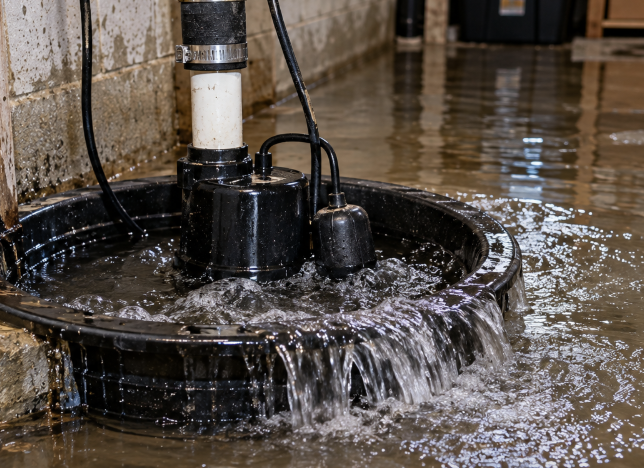
Yes. A sump pump failure can flood a basement surprisingly quickly when groundwater is entering the sump pit faster than the system can remove it. The pump does not have to be completely dead, either. A pump can still be humming, cycling, or moving some water and yet fall behind during a heavy rain event.
For a Vineland homeowner, the worst timing is also the most common timing: the pump fails when the ground is saturated, rain is still coming down, and the sump basin is filling faster than usual.
If the water rises above the top of the pit, it can spread across the basement floor, soak carpet and padding, wick into drywall, reach insulation and framing, and damage boxes, furniture, utilities, and anything stored at floor level.
The first job is to get the sump system working again. The second job is to deal with the water that already escaped.
If Your Sump Pit Is Rising Right Now
- Do not step into standing water if electricity may be involved.
- Check whether the pump has power from a dry, safe location.
- Do not reach into an energized sump pit.
- Call a plumber or sump-system professional if the pump is not operating correctly.
- Move dry belongings away from the spreading water if it is safe to do so.
- Photograph the pit, water level, damaged materials, and affected contents.
- Begin water extraction once the area is safe.
How Does a Failed Sump Pump Flood a Basement?
A sump system normally gives groundwater somewhere to go.
Drainage around or beneath the foundation directs water toward the sump basin. As the water rises, the pump activates and sends it through a discharge line away from the house.
When that process breaks down, the drainage system may keep doing its job perfectly well—continuing to deliver water into the pit—while the pump fails to get it back out.
Eventually:
water entering the pit > water leaving the pit = basement flood.
That is why a sump pump failure during a dry week may go unnoticed, while the same failure during a long South Jersey rainstorm can become an emergency.
A Sump Pump Does Not Have to Stop Completely to Fail
This catches homeowners off guard.
You walk downstairs, hear the pump running, and assume everything is fine.
Not necessarily.
The pump can be operating and still lose the race against incoming water.
| What You Notice | What Could Be Happening |
|---|---|
| Pump runs constantly | Groundwater may be entering faster than the system normally handles, or the pump may be losing efficiency. |
| Water level barely drops | The pump may be undersized, partially clogged, worn, or fighting a restricted discharge line. |
| Pump turns on and off every few seconds | Short cycling may point to float, check-valve, basin, or system-design problems. |
| Pump runs but water returns | A check valve or discharge problem may be allowing water back toward the pit. |
| Pump hums but does not move water | The impeller, intake, motor, or discharge may be obstructed or failing. |
If the pit keeps rising while the pump is running, treat that as a warning—not reassurance.
The Most Common Reasons Sump Pumps Fail
There is no single “sump pump failure.” Several different things can produce the same puddle on the basement floor.
Power Outage
This is the cruel irony of a sump system: the weather that sends the most water toward the basement can also knock out the electricity running the pump.
New Jersey’s Office of Emergency Management specifically recommends installing sump pumps with backup power as a flood-prevention measure.[1]
If the main pump depends entirely on utility power and the lights go out during a thunderstorm, the basin can continue filling while the pump sits idle.
Stuck Float Switch
The float is what tells many sump pumps when the water level has risen high enough to turn on.
If it becomes jammed against the basin wall, tangled with a cord, obstructed by debris, or mechanically fails, the pump itself may be perfectly functional but never receive the signal to start.
This is one of the reasons simply hearing the motor run during a quick test is not enough. The float needs room to move normally.
Blocked Intake
Debris, sediment, gravel, or sludge around the bottom of the pit can interfere with water reaching the pump or the pump’s impeller.
A system that has not been inspected for years can fail at exactly the moment the basin is receiving its highest water load.
Clogged or Frozen Discharge Line
The pump can only move water if the water has somewhere to go.
A blocked discharge pipe creates a traffic jam on the other side of the pump.
During winter weather, exposed portions of the discharge can also freeze if the system is not properly configured, potentially leaving the pump unable to discharge normally.
Mechanical Wear
A sump pump is a mechanical device. Motors, switches, bearings, impellers, seals, and other parts wear out.
A pump that has spent years cycling during storms may not fail gracefully. Sometimes it simply stops.
The Pump Is Too Small for the Water Load
Sometimes nothing is technically “broken.”
The system just cannot keep up.
If groundwater is entering the basin at 30 gallons per minute and the system can effectively remove only 20 under the actual lift and piping conditions, the math eventually wins.
The pump runs continuously while the water level climbs.
The Discharge Sends Water Back Toward the House
Pumping water outside is not enough if the discharge point sends it right back toward the foundation.
Water released too close to the house can soak into the surrounding soil and make its way back toward the basement drainage system.
You wind up pumping some of the same water more than once.
Why This Is Especially Worth Thinking About in Vineland
Vineland reports approximately 47.6 inches of average annual rainfall and describes its summers as humid.[2]
That does not mean every Vineland home needs a sump pump or that every basement is flood-prone.
It does mean a working groundwater-management system has a real job to do on properties that rely on one.
And New Jersey has been planning more broadly for increasing precipitation and flood risk. A state assessment prepared for Vineland specifically discusses increased precipitation, more intense short-duration rain events, and the need to plan for increased flooding.[3]
A homeowner does not need to wait for a named hurricane or regional flood to have a basement problem. One hard thunderstorm plus a failed pump can be enough.
What Are the Warning Signs Before a Sump Pump Fails?
Sump pumps occasionally fail without warning. More often, the system gives you something to notice first.
Pay attention to:
- A pump that runs much longer than it used to
- Rapid on-and-off cycling
- Grinding, rattling, buzzing, or humming noises
- A float that sticks or catches
- Water that remains unusually high in the basin
- Visible rust or corrosion
- A discharge pipe that shakes excessively
- Water returning to the pit after shutdown
- Persistent wet ground near the discharge point
- A breaker that trips repeatedly
- A pump that does nothing when the float rises
If you notice one of those signs on a sunny Tuesday, that is the inexpensive time to investigate it.
The expensive time is 2:00 a.m. during a storm with water crossing the basement floor.
How Do You Test a Sump Pump Before It Rains?
For many residential systems, a basic functional test is straightforward.
Follow the manufacturer’s instructions for your specific pump, but a common approach is to slowly add clean water to the basin and watch what happens.
You want to see the entire sequence:
- The water level rises.
- The float or switch activates.
- The pump starts without unusual noise.
- The water level drops noticeably.
- Water discharges outside in the expected location.
- The pump shuts off at the proper level.
- The basin does not immediately refill with discharged water.
You’re not just testing whether the motor makes noise. You’re testing whether the system moves water.
What Should You Check Outside?
Follow the discharge line.
Homeowners spend a lot of time staring at the pump and forget that half the system is outside the basement.
Look for:
- A crushed or disconnected discharge pipe
- Obstructions
- Water dumping immediately beside the foundation
- Erosion around the outlet
- Standing water that flows back toward the house
- Frozen sections during cold weather
A strong pump connected to a bad discharge setup can still leave you with a water problem.
Is a Battery Backup Sump Pump Worth It in New Jersey?
If the basement depends heavily on the sump system to stay dry, backup protection is worth serious consideration.
NJOEM explicitly recommends sump pumps with backup power as a household flood-prevention measure.[1]
The reason is simple: rain and power outages have an unfortunate habit of happening together.
Backup options may include:
- Battery-powered secondary sump pumps
- Backup battery systems
- A second primary pump in some configurations
- High-water alarms
- Other backup systems recommended for the property
The right setup depends on the basin, expected groundwater volume, discharge system, power availability, and how costly a basement flood would be.
A finished basement with bedrooms, a home office, furniture, electronics, and drywall has a very different risk profile from an unfinished utility basement with everything stored on raised plastic shelving.
A High-Water Alarm May Be the Cheapest Useful Upgrade
A backup pump helps move water.
An alarm helps make sure you know there is a problem.
A high-water alarm can alert you when the sump level rises beyond its normal operating range.
That can turn:
“Why is the pump running so much?”
into a warning before:
“Why is there water under the couch?”
Some systems can also provide remote alerts when nobody is home.
What Should You Do If the Pump Has Already Overflowed?
Once water has crossed the edge of the sump basin, this is no longer just a pump-repair problem.
Now you have a water-damage problem too.
First: Stay Out if Electricity Is a Concern
Do not walk through standing water if outlets, extension cords, appliances, wiring, a furnace, water heater, or electrical equipment may be energized.
If power cannot safely be controlled from a dry location, bring in someone qualified to deal with the electrical hazard.
Second: Restore the Sump System
A plumber or sump professional may need to repair or replace the pump, float, check valve, discharge line, or other failed component.
That stops the basement from continuing to take on water through the same failure.
Third: Remove the Water That Escaped
Do not wait for the basement floor to “dry naturally” if significant water has spread through the room.
Professional Basement Water Extraction in Vineland can remove standing water before it continues absorbing into surrounding materials.
Fourth: Check Beyond the Sump Pit
The damage almost never stops exactly where the visible water stopped.
Check:
- Carpet and padding
- Finished flooring
- Baseboards
- Bottom edges of drywall
- Insulation
- Wood framing
- Closets
- Cabinet bases
- Cardboard storage
- Furniture legs
A basement can look dramatically better after extraction while still holding moisture in all the wrong places.
How Much Water Can a Sump Pump Failure Put Into a Basement?
There is no useful universal number because the pump itself is not creating the water.
The amount depends on how quickly groundwater is entering and how long the system remains unable to remove it.
A pump failure discovered in ten minutes may produce a manageable puddle.
The exact same failure while a family is away for the weekend can saturate an entire finished basement.
That is why alarms, backup systems, and periodically checking the pump matter more than trying to memorize an average number of gallons.
Does Water From a Sump Pump Failure Count as Clean Water?
Do not assume that because the water looks clear it should be treated like drinking water from a broken supply line.
Sump pits typically collect groundwater or drainage water from around the foundation. Depending on the event, that water can pick up soil, microorganisms, chemicals, debris, and other contaminants before entering the building.
Weather-related groundwater and floodwater deserve a more cautious evaluation than a known clean plumbing supply-line loss.
If sewage or a drain backup is involved at the same time, the situation changes further and professional Sewage Backup Cleanup in Vineland may be appropriate.
Will the Basement Dry Once the Pump Starts Working Again?
No—not necessarily.
Getting the sump system back online solves the water-management failure.
It does not extract water from carpet padding.
It does not remove moisture from drywall.
It does not dry insulation.
It does not tell you whether wood framing is still wet.
Once water is inside the building, you have to treat the building.
Professional Structural Drying in Vineland addresses moisture that remains inside building materials after the standing water is removed.
Can Sump Pump Failure Cause Mold?
Yes, if materials remain wet.
EPA guidance recommends drying water-damaged areas and materials within approximately 24–48 hours when possible to reduce the likelihood of mold growth.[4]
That is not an exact countdown clock. Mold growth depends on moisture, temperature, material type, and other conditions.
But a finished basement gives water plenty of absorbent places to hide:
- Drywall paper
- Carpet
- Carpet padding
- Wood framing
- Insulation
- Cardboard
- Furniture
The practical lesson is simple: once the pump is repaired, do not stop paying attention to the basement.
What If the Basement Smells Musty a Few Days Later?
That deserves investigation.
A musty odor after a sump-pump flood can mean:
- Carpet padding is still damp.
- Water remains beneath flooring.
- Drywall or insulation stayed wet.
- Stored cardboard or furniture is holding moisture.
- Mold has begun growing in a concealed area.
Do not start with air freshener.
Start with: what is still wet?
If mold has developed after the water loss, PuroClean also provides professional Mold Remediation in Vineland.
Does Homeowners Insurance Cover a Sump Pump Failure?
Sometimes, but this is one coverage area where homeowners should check the actual policy rather than assume.
Water-backup and sump-pump-overflow coverage may be offered as an optional endorsement, and limits can differ from the rest of the homeowners policy.
If a sump failure floods your basement:
- Photograph the sump pit and apparent failure.
- Photograph the water before major cleanup when safe.
- Document damaged flooring, walls, furniture, and belongings.
- Contact the carrier or agent promptly.
- Ask specifically whether the policy includes water-backup or sump coverage.
- Keep restoration invoices and drying documentation.
Insurance coverage and water mitigation are two separate questions. Do not intentionally leave the basement wet while waiting for a coverage answer.
When a Sump Pump Problem Becomes a Restoration Problem
If the water never left the pit, you probably need a sump-pump professional.
If the water is now across the floor, under the carpet, inside the drywall, or around your belongings, you have crossed into restoration territory.
That is the clean dividing line.
A plumber or sump contractor fixes the equipment. A restoration company deals with what happened to the building after the equipment failed.
If you are unsure how far the water traveled, professional moisture detection can answer that before new carpet, drywall, trim, or furniture goes back into the space.
PuroClean of Vineland provides professional Sump Pump Failure Cleanup in Vineland, including water extraction, moisture detection, evaluation of affected materials, and structural drying after a pump-related basement flood.
Before the Next Big Rain: A 10-Minute Sump Pump Check
You do not need to become a sump-pump technician.
You do need to know whether the system you are counting on appears ready to work.
- Look inside the pit for debris.
- Make sure the float has room to move.
- Check that the pump is plugged in securely.
- Look for damaged cords.
- Test the pump according to the manufacturer’s instructions.
- Confirm that water actually leaves the basin.
- Walk outside and look at the discharge point.
- Make sure discharge water moves away from the foundation.
- Test any battery backup.
- Test any high-water alarm.
Do that before the radar turns red, not after.
Sump Pump Failure FAQs
Can a sump pump overflow even if it is running?
Yes. If groundwater enters faster than the pump can remove it, the basin can continue rising even while the motor runs continuously.
Why did my sump pump suddenly stop?
Possible causes include loss of power, float-switch failure, a blocked intake, a clogged or frozen discharge line, mechanical wear, or a failed motor.
Why does my sump pump run constantly when it rains?
The drainage system may be collecting a large volume of groundwater. Continuous operation can be normal during unusually wet conditions, but it can also indicate that the system is approaching its capacity or has a discharge or efficiency problem.
Can I unplug a noisy sump pump?
Not casually. If groundwater is entering the pit, unplugging the pump can remove the only thing preventing an overflow. If the pump is making abnormal sounds, have the system evaluated.
How do I know if the float switch is stuck?
The water may rise unusually high without the pump activating, or the pump may continue running after the basin is low. Do not reach into an energized pit to manipulate the float.
What if the power goes out during a storm?
A standard electric pump will not operate without electricity. Backup power or a secondary pump can provide additional protection. NJOEM specifically recommends backup power for sump systems.
Do I need both a sump pump and a French drain?
They do different jobs. A perimeter or French-drain-type system collects water; the sump pump removes water collected in the basin. Some properties use both as one groundwater-management system.
How do I know if water got behind my basement wall?
Moisture meters and other inspection methods can help identify elevated moisture in drywall, framing, baseboards, and concealed areas even when the visible surface is no longer wet.
Should I replace my carpet after a sump pump flood?
It depends on the water source, degree of saturation, how long it stayed wet, contamination, and whether the carpet, padding, and material underneath can be properly restored.
When should I call PuroClean?
If water has escaped the sump pit and affected flooring, walls, insulation, contents, or a significant portion of the basement—or if you simply cannot tell how far the moisture traveled—it makes sense to have the water damage professionally evaluated.
The One Thing I Would Not Trust to Luck
If your basement depends on a sump pump to stay dry, that pump is not just another appliance.
It is part of the building’s water-control system.
A refrigerator can quit and ruin the groceries. A sump pump can quit and hand the entire basement over to the groundwater.
Test it. Give it backup power if the property warrants it. Know where it discharges. And if it ever does overflow, do not stop at repairing the pump.
Make sure the basement itself is dry.
Related Vineland Water Damage Services
- Sump Pump Failure Cleanup Vineland
- Basement Flood Cleanup Vineland
- Basement Water Extraction Vineland
- Emergency Water Removal Vineland
- Structural Drying Vineland
- Mold Remediation Vineland
References
-
^
New Jersey Office of Emergency Management — Floods & Flash Floods -
^
City of Vineland — Climate and Community Information -
^
New Jersey Department of Environmental Protection / City of Vineland — State Plan Endorsement Opportunities & Constraints Assessment -
^
U.S. Environmental Protection Agency — A Brief Guide to Mold, Moisture and Your Home - ANSI/IICRC S500 — Standard for Professional Water Damage Restoration
Need Help After a Sump Pump Failure in Vineland?
If the pump has already overflowed, fixing the equipment is only half the job. Water may remain underneath flooring, inside carpet padding, behind baseboards, in drywall, around framing, or inside other materials even after the basement floor looks much better.
PuroClean of Vineland provides professional Sump Pump Failure Cleanup in Vineland, including standing-water extraction, moisture detection, structural drying, and evaluation of affected materials after pump-related basement flooding.